Ace - AI Tutor
Ask Our Educators
Textbooks
My Library
Flashcards
Scribe - AI Notes
Notes & Exams
Download App
ruben gould

ruben g.

Divider

Questions asked

BEST MATCH

Question 12 1 pts What is the primary purpose of "blinding" in an experimental study? ("Blinding" means patients and/or investigators are not made aware of the patients' treatment group allocation) Prevent patient's or investigator's knowledge of their treatment group (e.g., novel medicine vs. comparison medicine) influencing the outcome assessment (i.e., observation bias) Prevent patients with less severe disease (i.e., likely to have better prognosis) tend to self-select certain treatment. Obtain treatment groups with comparable distribution of potential confounding or prognostic factors. No answer text provided.

View Answer
divider
BEST MATCH

information about a sample is given. Assume that the sampling distribution is symmetric and bell-shaped. r =-.45 and the margin of error for 95% is .11

View Answer
divider
BEST MATCH

If θ = 56 and F = 450 N , determine the magnitude of the resultant force

View Answer
divider
BEST MATCH

Problem 5: Your goal is to design a power delivery system that delivers power to a 15 Ω load. The load will be at the end of a 5 km long transmission line with a resistance of 20 Ω/km. The voltage needed at the load is 120 $V_{rms}$. a) Find the voltage required at the source and the power efficiency of the system, $\eta = 100 \frac{P_{load}}{P_{source}}$, when no transformers are used in the circuit. (5 points) b) Assuming a single ideal transformer is utilized between the transmission line and the load, find the turns ratio, N, which would achieve a 98% power efficiency while keeping the voltage at the source as small as possible. The voltage at the load must still be 120 $V_{rms}$. (10 points)

View Answer
divider
BEST MATCH

Grades and Attendar Inbox-drattloj4vall Inbox-drattiojay@g Messeges | Schoology Try Ace AISTEM Tuto 2.3 Prelectinfo from Not secure webassign.net/web/Student/Assignment-Responses/submit?dep \( =348422408 \) tags-autosave\#question5504855_3 powerschoo gehoology Weansign parchment Tumitin 5. [-/1 Points] DETAILS MY NOTES SALGTRIG5 2.3.005. ASK YOUR TEACHER PRACTICE ANOTHER Refer to the graph of \( f \) shown below. (1) Screen capture - now Screenshot taken Show in folder The solutions of the equation \( f(x)=0 \) are the - -v -intercepts of the graph of \( f \). The solution of the inequality \( f(x) \geq 0 \) is the set of \( x \)-vali \( -2-v \)-axis. From the graph of \( f \) we find that the solutions of the equation \( f(x)=0 \) are \( x= \) \( \square \) . (Enter your answers as a comma-separat The solution of the inequality \( f(x) \geq 0 \) is \( \square \) . (Enter your answer using interval notation.) Need Help? Read it Copied to clipboard Search \( +V \) Edit Delete Submit Answer

View Answer
divider
BEST MATCH

Rx prozac liquid 120ml sig. 40mg po qaPo qam stock available fluoxetine oral solution 20mg/5ml what is the day's supply? write the directions as they should appear on the customer's bottle

View Answer
divider
BEST MATCH

An argument that is often made in order to undermine a particular position involves the suggestion that making exceptions to universal rules will ultimately lead to more frequent and more inappropriate exception-making. This is known as the slippery slope argument.

View Answer
divider
BEST MATCH

TB TF Qu. 01-31 (Static) Relative to explicit taxes, implicit taxes are muc... Relative to explicit taxes, implicit taxes are much easier to estimate. True or False True False

View Answer
divider
BEST MATCH

Let f, g : [a, b) → B be functions. Prove that if there is a number S > 0 so that f and g are equal on the subset {z ∈ [a, b) : |z - b| < S} of [a, b), then the left limit of f at b exists iff the left limit of g at b exists and in this case we have lim f(z) = lim g(z).

View Answer
divider
BEST MATCH

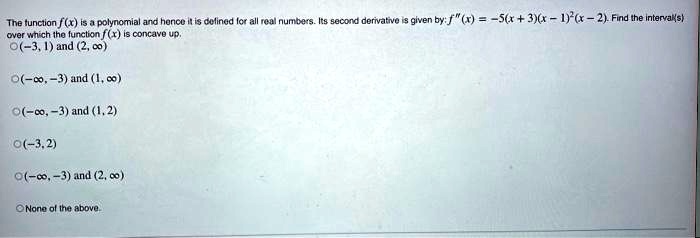
The function $f(x)$ is a polynomial and hence it is defined for all real numbers. Its second derivative is given by: $f''(x) = -5(x+3)(x-1)^2(x-2)$. Find the interval(s) over which the function $f(x)$ is concave up. $( -3, 1)$ and $(2, \infty)$ $( -\infty, -3)$ and $(1, \infty)$ $( -\infty, -3)$ and $(1, 2)$ $(-3, 2)$ $( -\infty, -3)$ and $(2, \infty)$ None of the above.
View Answer
divider