Ace - AI Tutor
Ask Our Educators
Textbooks
My Library
Flashcards
Scribe - AI Notes
Notes & Exams
Download App
ruben hodges

ruben h.

Divider

Questions asked

BEST MATCH

3 MULTIPLE CHOICE Which of the following is incorrect regarding ground reaction forces pertaining to a runner's foot exerting force on the ground? A The ground equally and oppositely reacts against the runner's foot to produce a ground reaction force. B The direction of the ground reaction force determines the runner's acceleration. C The magnitude of the ground reaction force determines the runner's acceleration. D Equal and opposite reactions pertain to Newton's first law of motion.

View Answer
divider
BEST MATCH

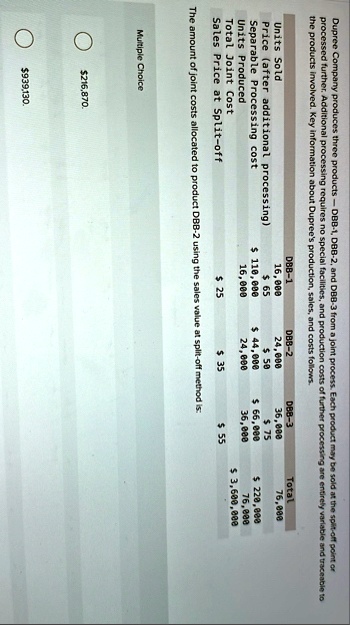
Dupree Company produces three products - DBB-1, DBB-2, and DBB-3 from a joint process. Each product may be sold at the split-off point or processed further. Additional processing requires no special facilities, and production costs of further processing are entirely variable and traceable to the products involved. Key information about Dupree's production, sales, and costs follows. Units Sold Price (after additional processing) Separable Processing cost Units Produced Total Joint Cost Sales Price at Split-off DBB-1 16,000 $ 65 $ 110,000 16,000 $ 25 DBB-2 24,000 $ 50 $ 44,000 24,000 $ 35 DBB-3 36,000 $ 75 $ 66,000 36,000 $ 55 Total 76,000 $ 220,000 76,000 $ 3,600,000 The amount of joint costs allocated to product DBB-2 using the sales value at split-off method is: Multiple Choice $216,870. $939,130.
View Answer
divider
BEST MATCH

To determine whether the series $\sum_{n=2}^{\infty} \frac{1}{(4n+4)^5}$ converges or diverges, we will use the integral test. Step 1: What are the conditions to be able to apply the integral test? (Mark all that apply) $\frac{1}{(4x+4)^5}$ is positive on $[2, \infty)$ $\frac{1}{(4x+4)^5}$ is differentiable $\frac{1}{(4x+4)^5}$ is decreasing on $[2, \infty)$ Step 2: Compute the class of anti-derivatives of $\frac{1}{(4x+4)^5}$. (Hint: u substitution) $-\frac{1}{16(4x+4)^4}+C$ Step 3: Compute $\int_2^M \frac{1}{(4x+4)^5} dx$ (Give your answer using variable $M$) $-\frac{1}{16(4M+4)^4}+\frac{1}{331776}$ Step 4: Compute the value of the improper integral (If the integral diverges to $\infty$, type oo; if the integral diverges to $-\infty$, type -oo; and if the integral diverges for some other reason, type DNE.) $\int_2^{\infty} \frac{1}{(4x+4)^5} dx = \frac{1}{331776}$ Use your answer to help determine whether the series $\sum_{n=2}^{\infty} \frac{1}{(4n+4)^5}$ converges or diverges. Enter C if the series is convergent, D if the series is divergent, or ? if the Integral Test does not apply: C To determine whether the series $\sum_{n=2}^{\infty} \frac{1}{\sqrt{4n+4}}$ converges or diverges, we will use the integral test. Step 1: What are the conditions to be able to apply the integral test? (Mark all that apply) $\frac{1}{\sqrt{4x+4}}$ is decreasing on $[2, \infty)$ $\frac{1}{\sqrt{4x+4}}$ is positive on $[2, \infty)$ $\frac{1}{\sqrt{4x+4}}$ is differentiable Step 2: Compute the class of anti-derivatives of $\frac{1}{\sqrt{4x+4}}$ $\frac{\sqrt{4x+4}}{2}+C$ Step 3: Compute $\int_2^M \frac{1}{\sqrt{4x+4}} dx$ (Give your answer using variable $M$) $\frac{\sqrt{4M+4}}{2}-\sqrt{3}$ Step 4: Compute the value of the improper integral (If the integral diverges to $\infty$, type oo; if the integral diverges to $-\infty$, type -oo; and if the integral diverges for some other reason, type DNE.) $\int_2^{\infty} \frac{1}{\sqrt{4x+4}} dx = oo$ ```

View Answer
divider
BEST MATCH

The figure above shows a solid insulating sphere of radius $R_2$ with charge $-Q$ (where $Q > 0$) distributed uniformly throughout the volume. This sphere is centered within a thin spherical shell of radius $R_1$, and a charge $+Q$ is distributed uniformly on the surface of the spherical shell. Far away from the sphere and the spherical shell, the electric potential is zero. Use $k$ for Coulomb's constant. A. At point $A$ on the surface of the spherical shell, what is the electric potential $V_A$? B. Point $B$ is on the surface of the sphere. What is the potential difference, $V_B - V_A$? C. Point $C$ is at the center of the sphere. What is the potential difference, $V_C - V_B$?

View Answer
divider
BEST MATCH

For a function $f(x)$ that is integrable on the interval $[a, b]$, the average value of $f$ on $[a, b]$ is given by $$f_{avg} = \frac{1}{b - a} \int_a^b f(x) dx$$ Consider the function $f(x) = 5x^2 - 20x + 15$. (a) Find the average value of $f$ on the interval $[-6, 6]$ $f_{avg} = \text{_____}$ (b) Find all possible values of $c \in [-6, 6]$ (including endpoints) such that $f(c) = f_{avg}$. $c = \text{_____}$ Note: Since $f$ is continuous on $[-6, 6]$, the Mean Value Theorem for Integrals states that at least one $c$ must exist.

View Answer
divider
BEST MATCH

(20 pts) Solve the following instance of the single-source shortest-paths problem with vertex $a$ as the source. Provide (shortest-path) tree vertices and edges that are chosen by the algorithm.

View Answer
divider
BEST MATCH

How many mL of a 0.153 M aqueous solution of silver nitrate, , must be taken to obtain 7.56 grams of the salt?

View Answer
divider
BEST MATCH

An internal control activity that separates responsibilities so that no one person handles all the tasks for a particular activity is referred to as

View Answer
divider
BEST MATCH

AACN Core curriculum for high acuity, progressive, and critical care nursing 7th ed

View Answer
divider
BEST MATCH

Question 13 Suppose that, in a Hidden Markov Model with three states, we have the estimates \( \xi_{t \mid t}=(0.2,0.6,0.2), \xi_{t+1 \mid t}=(0.3,0.4,0.3) \), and \( \xi_{t+1 \mid T}=(0.15,0.7,0.15) \). The transition matrix is given by: \[ P=\left(\begin{array}{ccc} 0.5 & 0.25 & 0.25 \\ 0.25 & 0.5 & 0.25 \\ 0.25 & 0.25 & 0.5 \end{array}\right) \] What are the optimal forecasts \( \xi_{t \mid T}(j) \) for each state \( j=\{1,2,3\} \) using backward smoothing (aka the Kim smoother)? \( \xi_{t \mid T}=(0.1625,0.675,0.1625) \) \( \xi_{t \mid T}=(0.125,0.75,0.125) \) \( \xi_{t \mid T}=(0.1125,0.775,0.1125) \) \( \xi_{t \mid T}=(0.15,0.7,0.15) \)

View Answer
divider