Problem 3.
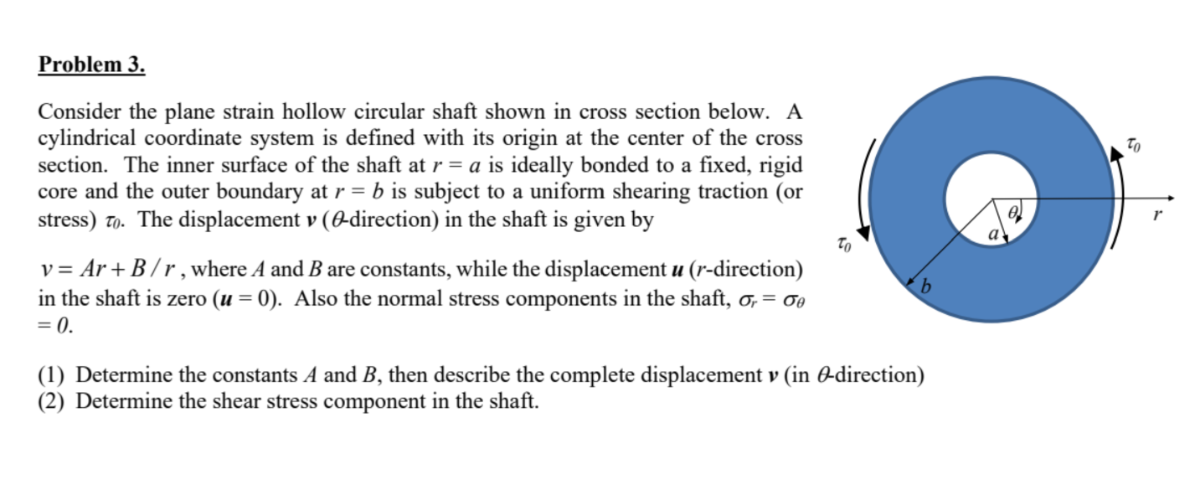
Consider the plane strain hollow circular shaft shown in cross section below. A cylindrical coordinate system is defined with its origin at the center of the cross section. The inner surface of the shaft at \( r=a \) is ideally bonded to a fixed, rigid core and the outer boundary at \( r=b \) is subject to a uniform shearing traction (or stress) \( \tau_{0} \). The displacement \( \boldsymbol{v} \) ( \( \theta \)-direction) in the shaft is given by
\( v=A r+B / r \), where \( A \) and \( B \) are constants, while the displacement \( \boldsymbol{u} \) ( \( r \)-direction) in the shaft is zero \( (\boldsymbol{u}=0) \). Also the normal stress components in the shaft, \( \sigma_{r}=\sigma_{\theta} \) \( =0 \).
(1) Determine the constants \( A \) and \( B \), then describe the complete displacement \( \boldsymbol{v} \) (in \( \theta \)-direction)
(2) Determine the shear stress component in the shaft.