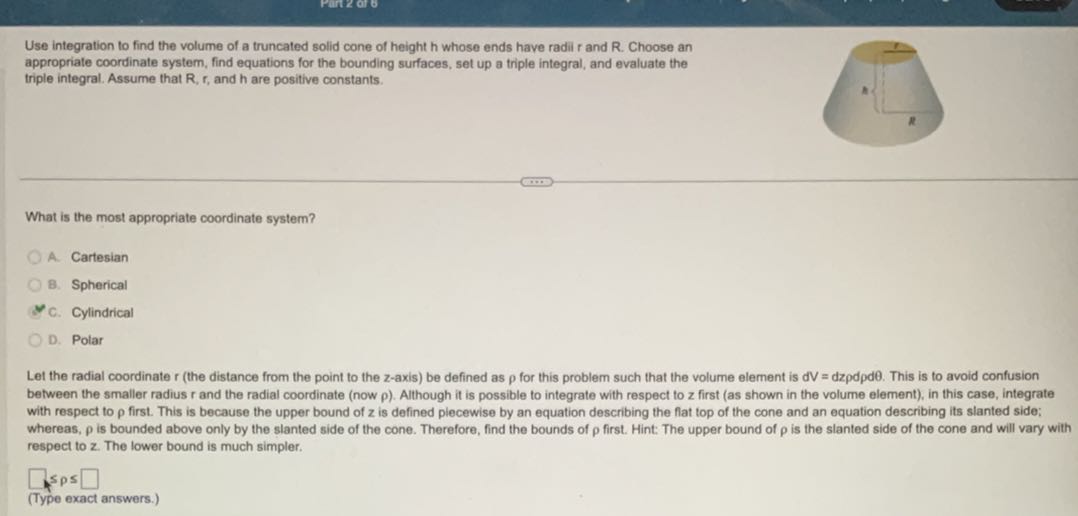
Use integration to find the volume of a truncated solid cone of height \( h \) whose ends have radii \( r \) and \( R \). Choose an appropriate coordinate system, find equations for the bounding surfaces, set up a triple integral, and evaluate the triple integral. Assume that R, r, and h are positive constants.
What is the most appropriate coordinate system?
A. Cartesian
B. Spherical
C. Cylindrical
D. Polar
Let the radial coordinate r (the distance from the point to the \( z \)-axis) be defined as \( \rho \) for this problem such that the volume element is \( d V=d z \rho d \rho d \theta \). This is to avoid confusion between the smaller radius \( r \) and the radial coordinate (now \( \rho \) ). Although it is possible to integrate with respect to \( z \) first (as shown in the volume element), in this case, integrate with respect to \( \rho \) first. This is because the upper bound of \( z \) is defined plecewise by an equation describing the flat top of the cone and an equation describing its slanted side: whereas, \( \rho \) is bounded above only by the slanted side of the cone. Therefore, find the bounds of \( \rho \) first. Hint: The upper bound of \( \rho \) is the slanted side of the cone and will vary with respect to \( z \). The lower bound is much simpler.
\( \square \) sps \( \square \)
(Type exact answers.)