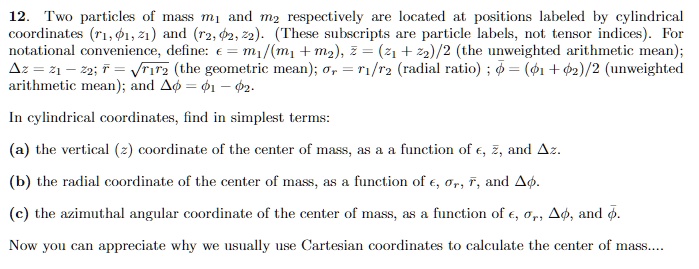
12. Two particles of mass m? and m? respectively are located at positions labeled by cylindrical coordinates (r?, ??, z?) and (r?, ??, z?). (These subscripts are particle labels, not tensor indices). For notational convenience, define: ? = m?/(m? + m?), \bar{z} = (z? + z?)/2 (the unweighted arithmetic mean); ?z = z? - z?; \bar{r} = \sqrt{r?r?} (the geometric mean); ?r = r?/r? (radial ratio); \bar{?} = (?? + ??)/2 (unweighted arithmetic mean); and ?? = ?? - ??.
In cylindrical coordinates, find in simplest terms:
(a) the vertical (z) coordinate of the center of mass, as a function of ?, \bar{z}, and ?z.
(b) the radial coordinate of the center of mass, as a function of ?, ?r, \bar{r}, and ??.
(c) the azimuthal angular coordinate of the center of mass, as a function of ?, ?r, ??, and \bar{?}.
Now you can appreciate why we usually use Cartesian coordinates to calculate the center of mass....