From the rightmost digit, which is the check digit, moving left, double the value of every second digit; if the product of this doubling operation is greater than 9
(e.g., 7*2 = 14), then sum the digits of the products (e.g., 10: 1+0= 1, 14: 1 + 4 = 5).
Take the sum of all the digits. If the total modulo 10 is equal to 0 (if the total ends in zero) then the number is valid according to the Luhn formula; else it is
not valid.
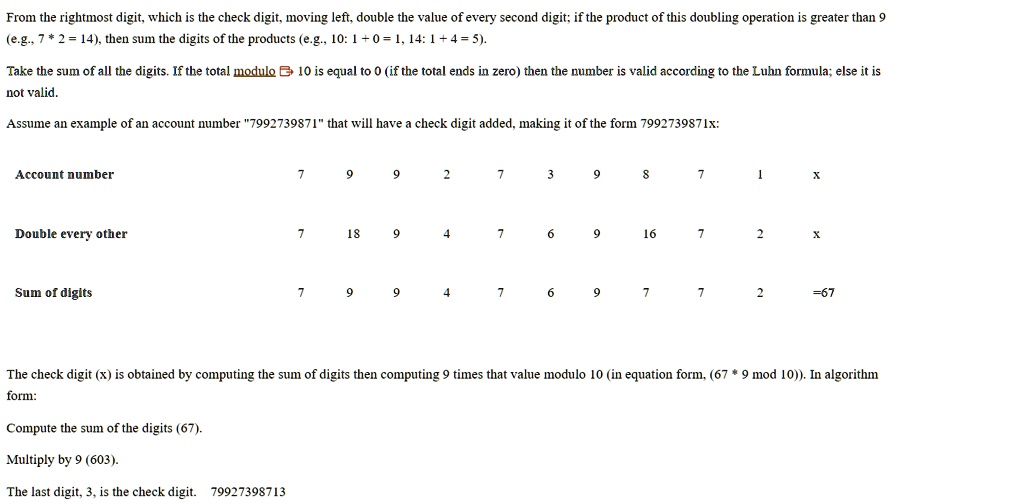
Assume an example of an account number "7992739871" that will have a check digit added, making it of the form 7992739871x:
Account number
7
9
9
2
7
3
9
8
7
1
X
Double every other
7
18
9
4
7
6
9
16
7
2
X
Sum of digits
7
9
9
4
7
6
9
7
7
2
=67
The check digit (x) is obtained by computing the sum of digits then computing 9 times that value modulo 10 (in equation form, (67* 9 mod 10)). In algorithm
form:
Compute the sum of the digits (67).
Multiply by 9 (603).
The last digit, 3, is the check digit. 79927398713