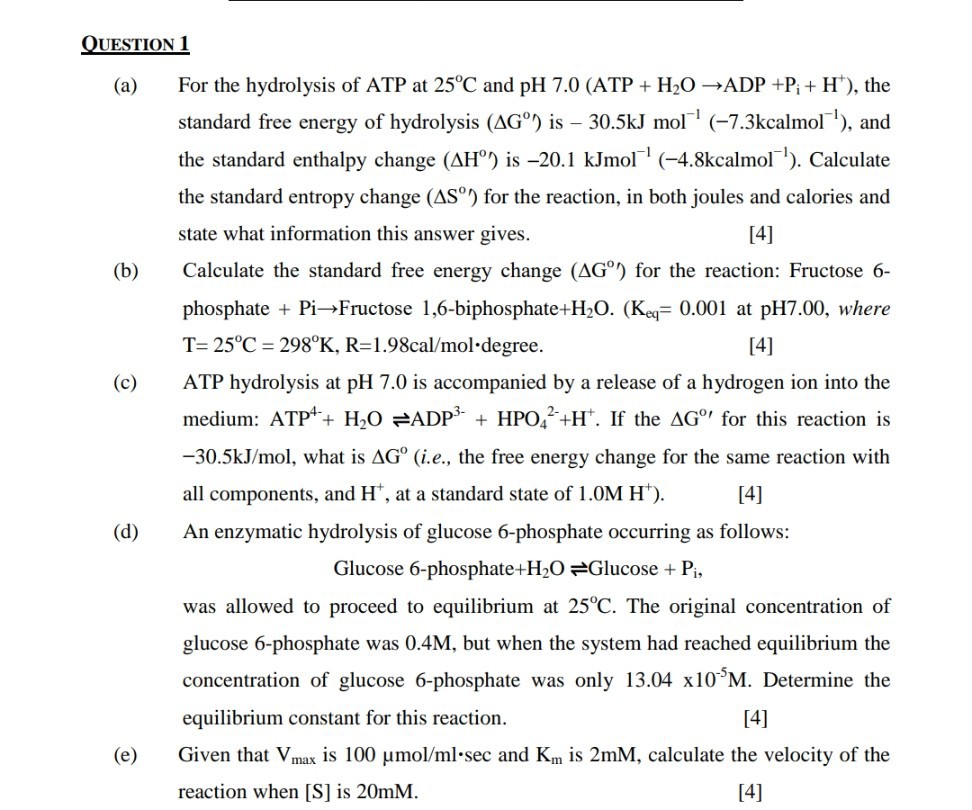
QUESTION 1
(a) For the hydrolysis of ATP at \( 25^{\circ} \mathrm{C} \) and pH \( 7.0\left(\mathrm{ATP}+\mathrm{H}_{2} \mathrm{O} \rightarrow \mathrm{ADP}+\mathrm{P}_{\mathrm{i}}+\mathrm{H}^{+}\right) \), the standard free energy of hydrolysis \( \left(\Delta \mathrm{G}^{\circ}\right) \) is \( -30.5 \mathrm{~kJ} \mathrm{~mol}^{-1}\left(-7.3 \mathrm{kcalmol}^{-1}\right) \), and the standard enthalpy change \( \left(\Delta \mathrm{H}^{\circ}\right) \) is \( -20.1 \mathrm{kJmol}^{-1}\left(-4.8 \mathrm{kcalmol}^{-1}\right) \). Calculate the standard entropy change \( \left(\Delta \mathrm{S}^{\circ}\right) \) for the reaction, in both joules and calories and state what information this answer gives.
(b) Calculate the standard free energy change \( \left(\Delta G^{\circ}\right) \) for the reaction: Fructose 6phosphate \( +\mathrm{Pi} \rightarrow \) Fructose 1,6-biphosphate \( +\mathrm{H}_{2} \mathrm{O} .\left(\mathrm{K}_{\mathrm{eq}}=0.001\right. \) at pH 7.00 , where \( \mathrm{T}=25^{\circ} \mathrm{C}=298^{\circ} \mathrm{K}, \mathrm{R}=1.98 \mathrm{cal} / \mathrm{mol} \cdot \) degree.
(c) ATP hydrolysis at pH 7.0 is accompanied by a release of a hydrogen ion into the medium: \( \mathrm{ATP}^{4-}+\mathrm{H}_{2} \mathrm{O} \rightleftharpoons \mathrm{ADP}^{3-}+\mathrm{HPO}_{4}{ }^{2-}+\mathrm{H}^{+} \). If the \( \Delta \mathrm{G}^{\mathrm{o}} \) for this reaction is \( -30.5 \mathrm{~kJ} / \mathrm{mol} \), what is \( \Delta \mathrm{G}^{\mathrm{o}} \) (i.e., the free energy change for the same reaction with all components, and \( \mathrm{H}^{+} \), at a standard state of \( 1.0 \mathrm{M} \mathrm{H}^{+} \)).
(d) An enzymatic hydrolysis of glucose 6-phosphate occurring as follows:
\[
\text { Glucose 6-phosphate }+\mathrm{H}_{2} \mathrm{O} \rightleftharpoons \text { Glucose }+\mathrm{P}_{\mathrm{i}}
\]
was allowed to proceed to equilibrium at \( 25^{\circ} \mathrm{C} \). The original concentration of glucose 6-phosphate was 0.4 M , but when the system had reached equilibrium the concentration of glucose 6-phosphate was only \( 13.04 \times 10^{-5} \mathrm{M} \). Determine the equilibrium constant for this reaction.
(e) Given that \( \mathrm{V}_{\max } \) is \( 100 \mu \mathrm{~mol} / \mathrm{ml} \cdot \mathrm{sec} \) and \( \mathrm{K}_{\mathrm{m}} \) is 2 mM , calculate the velocity of the reaction when \( [\mathrm{S}] \) is 20 mM .
[4]