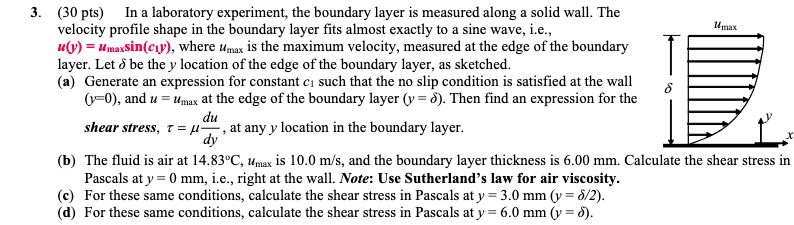
3. (30 pts) In a laboratory experiment, the boundary layer is measured along a solid wall. The velocity profile shape in the boundary layer fits almost exactly to a sine wave, i.e.,
$u(y) = u_{max}sin(c_1y)$, where $u_{max}$ is the maximum velocity, measured at the edge of the boundary layer. Let $\delta$ be the y location of the edge of the boundary layer, as sketched.
(a) Generate an expression for constant $c_1$ such that the no slip condition is satisfied at the wall (y=0), and $u = u_{max}$ at the edge of the boundary layer (y = $\delta$). Then find an expression for the shear stress, $\tau = \mu \frac{du}{dy}$, at any y location in the boundary layer.
(b) The fluid is air at 14.83°C, $u_{max}$ is 10.0 m/s, and the boundary layer thickness is 6.00 mm. Calculate the shear stress in Pascals at y = 0 mm, i.e., right at the wall. Note: Use Sutherland's law for air viscosity.
(c) For these same conditions, calculate the shear stress in Pascals at y = 3.0 mm (y = $\delta$/2).
(d) For these same conditions, calculate the shear stress in Pascals at y = 6.0 mm (y = $\delta$).