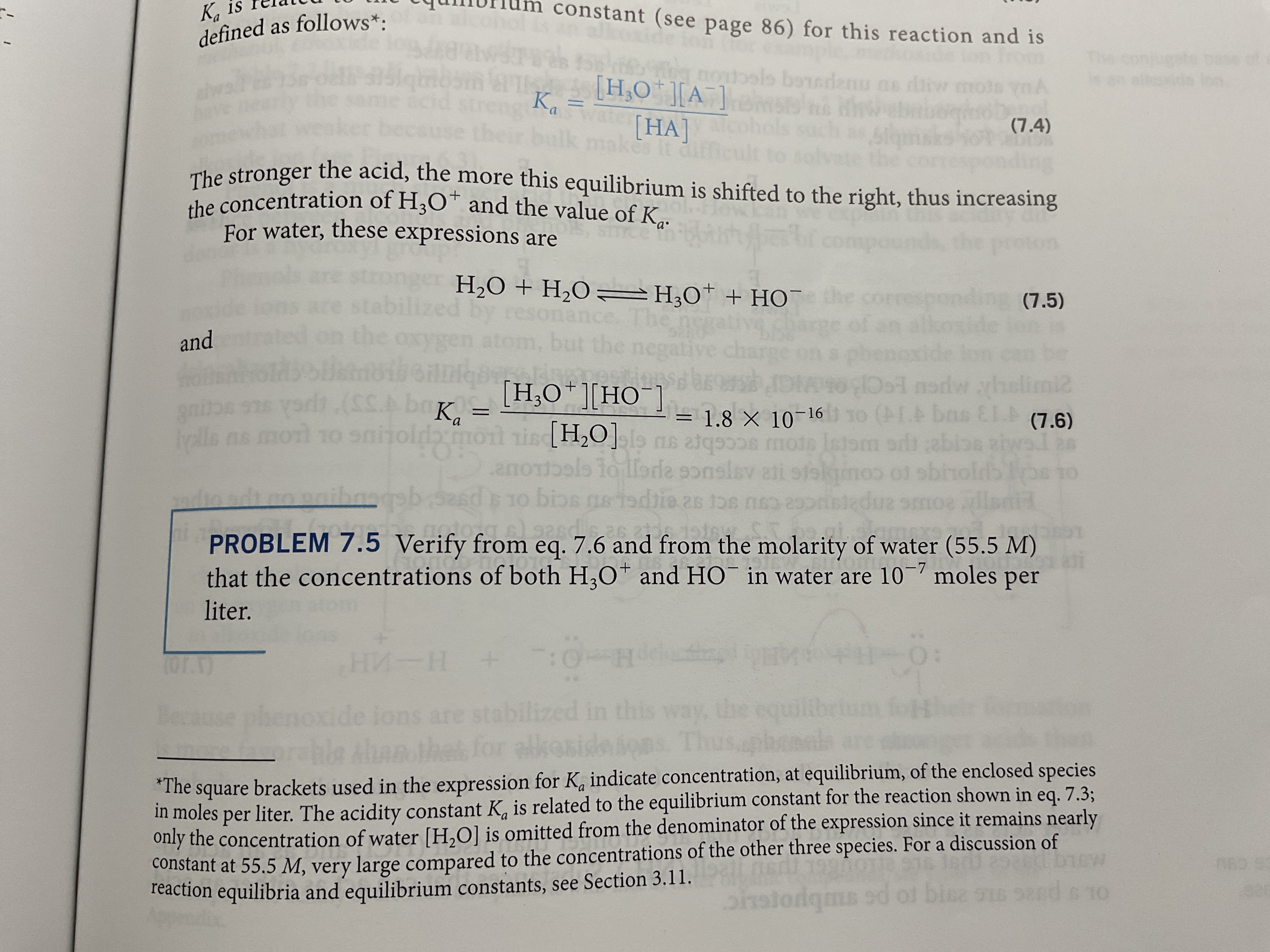
defined as follows*:
constant (see page 86) for this reaction and is
\[
K_{a}=\frac{\left[\mathrm{H}_{3} \mathrm{O}^{+}\right]\left[\mathrm{A}^{-}\right]}{[\mathrm{HA}]}
\]
The stronger the acid, the more this equilibrium is shifted to the right, thus increasing the concentration of \( \mathrm{H}_{3} \mathrm{O}^{+} \)and the value of \( K_{a} \).
For water, these expressions are
\[
\mathrm{H}_{2} \mathrm{O}+\mathrm{H}_{2} \mathrm{O} \rightleftharpoons \mathrm{H}_{3} \mathrm{O}^{+}+\mathrm{HO}^{-}
\]
and
\[
K_{a}=\frac{\left[\mathrm{H}_{3} \mathrm{O}^{+}\right]\left[\mathrm{HO}^{-}\right]}{\left[\mathrm{H}_{2} \mathrm{O}\right]}=1.8 \times 10^{-16}
\]
PROBLEM 7.5 Verify from eq. 7.6 and from the molarity of water (55.5 M) that the concentrations of both \( \mathrm{H}_{3} \mathrm{O}^{+} \)and \( \mathrm{HO}^{-} \)in water are \( 10^{-7} \) moles per liter.
*The square brackets used in the expression for \( K_{a} \) indicate concentration, at equilibrium, of the enclosed species in moles per liter. The acidity constant \( K_{a} \) is related to the equilibrium constant for the reaction shown in eq. 7.3; only the concentration of water \( \left[\mathrm{H}_{2} \mathrm{O}\right] \) is omitted from the denominator of the expression since it remains nearly constant at \( 55.5 \mathrm{M} \), very large compared to the concentrations of the other three species. For a discussion of reaction equilibria and equilibrium constants, see Section 3.11.