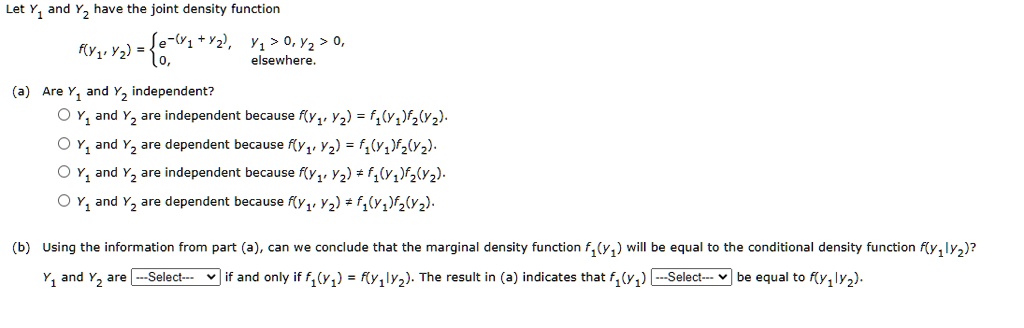
Let $Y_1$ and $Y_2$ have the joint density function
$\f(y_1, y_2) = \begin{cases} e^{-(y_1 + y_2)}, & y_1 > 0, y_2 > 0, \\ 0, & \text{elsewhere.} \end{cases}$
(a) Are $Y_1$ and $Y_2$ independent?
$\circ$ $Y_1$ and $Y_2$ are independent because $f(y_1, y_2) = f_1(y_1)f_2(y_2)$.
$\circ$ $Y_1$ and $Y_2$ are dependent because $f(y_1, y_2) = f_1(y_1)f_2(y_2)$.
$\circ$ $Y_1$ and $Y_2$ are independent because $f(y_1, y_2) \ne f_1(y_1)f_2(y_2)$.
$\circ$ $Y_1$ and $Y_2$ are dependent because $f(y_1, y_2) \ne f_1(y_1)f_2(y_2)$.
(b) Using the information from part (a), can we conclude that the marginal density function $f_1(y_1)$ will be equal to the conditional density function $f(y_1|y_2)$?
$Y_1$ and $Y_2$ are ---Select--- if and only if $f_1(y_1) = f(y_1|y_2)$. The result in (a) indicates that $f_1(y_1)$ ---Select--- be equal to $f(y_1|y_2)$.