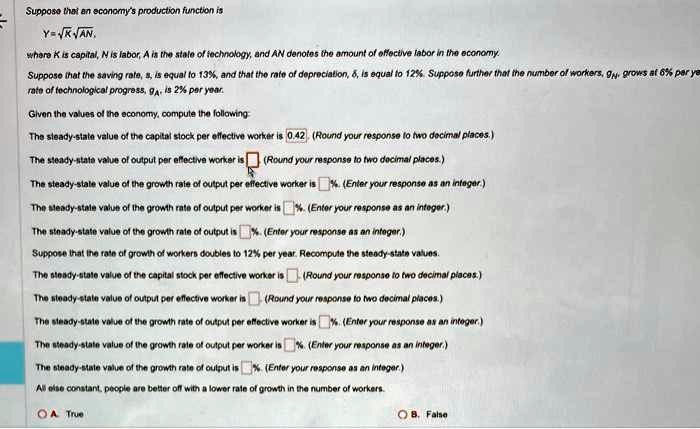
Suppose that an economy's production function is
Y = \sqrt{K \sqrt{AN}}
where K is capital, N is labor, A is the state of technology, and AN denotes the amount of effective labor in the economy.
Suppose that the saving rate, s, is equal to 13%, and that the rate of depreciation, \delta, is equal to 12%. Suppose further that the number of workers, $g_N$, grows at 6% per year.
rate of technological progress, $g_A$, is 2% per year.
Given the values of the economy, compute the following:
The steady-state value of the capital stock per effective worker is 0.42 (Round your response to two decimal places.)
The steady-state value of output per effective worker is (Round your response to two decimal places.)
The steady-state value of the growth rate of output per effective worker is %. (Enter your response as an integer.)
The steady-state value of the growth rate of output per worker is %. (Enter your response as an integer.)
The steady-state value of the growth rate of output is %. (Enter your response as an integer.)
Suppose that the rate of growth of workers doubles to 12% per year. Recompute the steady-state values.
The steady-state value of the capital stock per effective worker is (Round your response to two decimal places.)
The steady-state value of output per effective worker is (Round your response to two decimal places.)
The steady-state value of the growth rate of output per effective worker is %. (Enter your response as an integer.)
The steady-state value of the growth rate of output per worker is %. (Enter your response as an integer.)
The steady-state value of the growth rate of output is %. (Enter your response as an integer.)
All else constant, people are better off with a lower rate of growth in the number of workers.
A. True
B. False