2. Inference in Bayesian Networks [30 points]
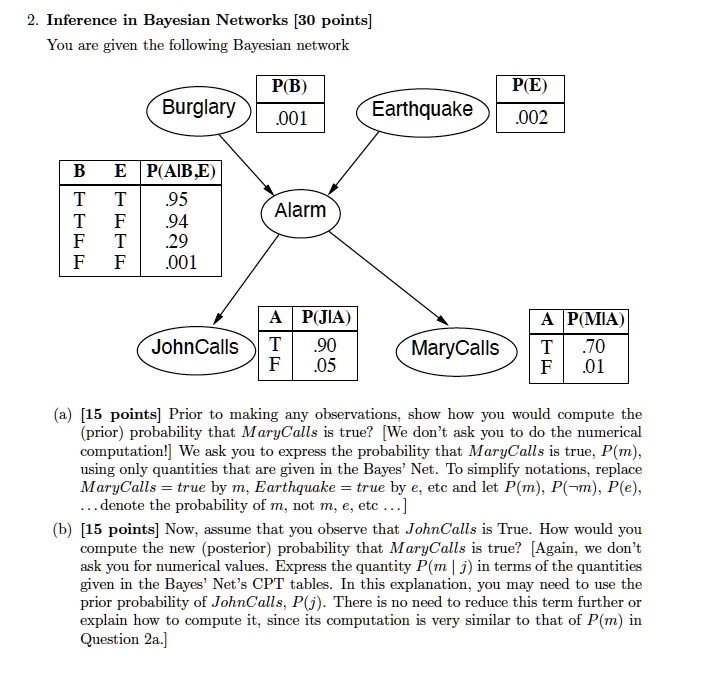
You are given the following Bayesian network
P(B)
Burglary
.001
Earthquake
P(E)
.002
B
E P(AIB,E)
T T
.95
Alarm
T F
.94
F T
.29
F F
.001
A P(JIA)
A P(MIA)
JohnCalls
T .90
MaryCalls
T .70
F .05
F .01
(a) [15 points] Prior to making any observations, show how you would compute the
(prior) probability that MaryCalls is true? [We don't ask you to do the numerical
computation!] We ask you to express the probability that MaryCalls is true, P(m),
using only quantities that are given in the Bayes' Net. To simplify notations, replace
MaryCalls = true by m, Earthquake = true by e, etc and let P(m), P(-m), P(e),
... denote the probability of m, not m, e, etc...]
(b) [15 points] Now, assume that you observe that JohnCalls is True. How would you
compute the new (posterior) probability that MaryCalls is true? [Again, we don't
ask you for numerical values. Express the quantity P(m | j) in terms of the quantities
given in the Bayes' Net's CPT tables. In this explanation, you may need to use the
prior probability of JohnCalls, P(j). There is no need to reduce this term further or
explain how to compute it, since its computation is very similar to that of P(m) in
Question 2a.]