Leveling of a Paint Film
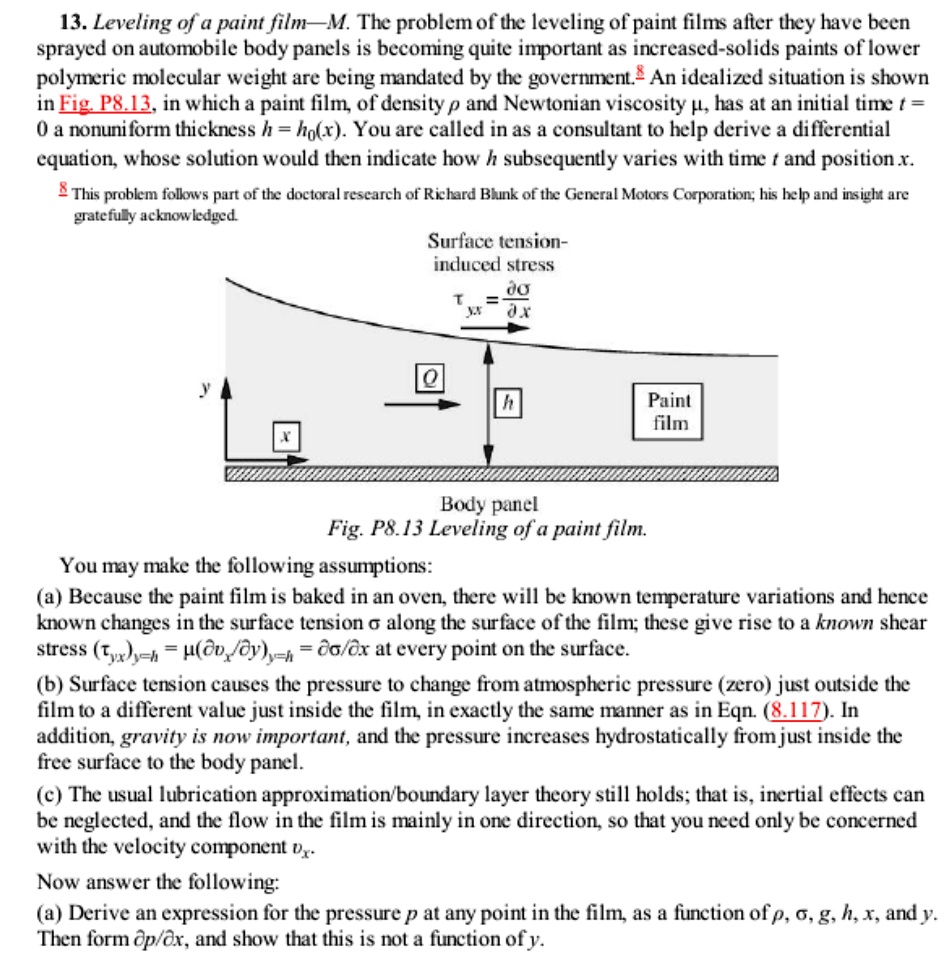
The problem of the leveling of paint films after they have been sprayed on automobile body panels is becoming quite important as increased-solids paints of lower polymeric molecular weight are being mandated by the government. An idealized situation is shown in Fig.P8.13, in which a paint film, of density p and Newtonian viscosity, has at an initial time t = 0 a nonuniform thickness h = ho(x). You are called in as a consultant to help derive a differential equation, whose solution would then indicate how h subsequently varies with time t and position x. This problem follows part of the doctoral research of Richard Blunk of the General Motors Corporation; his help and insight are gratefully acknowledged.
Surface tension-induced stress a0 T xe^(-x)
h
Paint film
Body panel
Fig.P8.13: Leveling of a paint film
You may make the following assumptions:
a) Because the paint film is baked in an oven, there will be known temperature variations and hence known changes in the surface tension σ along the surface of the film. These give rise to a known shear stress (τxy)y=h = (σ/σy)y=h = σ/dx at every point on the surface.
b) Surface tension causes the pressure to change from atmospheric pressure (zero) just outside the film to a different value just inside the film in exactly the same manner as in Eqn.(8.117). In addition, gravity is now important, and the pressure increases hydrostatically from just inside the free surface to the body panel.
c) The usual lubrication approximation/boundary layer theory still holds; that is, inertial effects can be neglected, and the flow in the film is mainly in one direction, so that you need only be concerned with the velocity component u.
Now answer the following:
a) Derive an expression for the pressure p at any point in the film, as a function of σ, g, h, x, and y. Then form ∂p/∂x, and show that this is not a function of y.