Ace - AI Tutor
Ask Our Educators
Textbooks
My Library
Flashcards
Scribe - AI Notes
Notes & Exams
Download App
sabrina obrien

sabrina o.

Divider

Questions asked

BEST MATCH

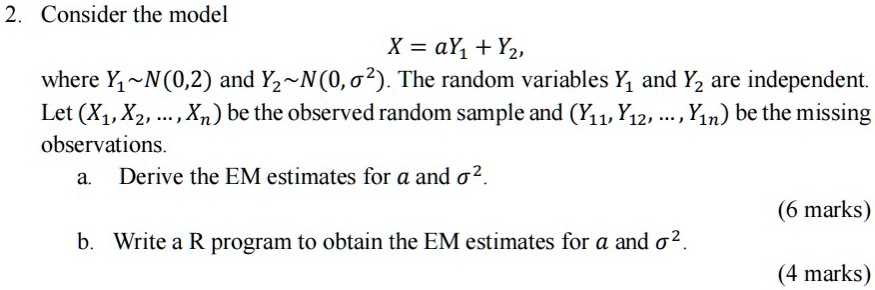
2. Consider the model $X = aY_1 + Y_2$, where $Y_1 \sim N(0,2)$ and $Y_2 \sim N(0, \sigma^2)$. The random variables $Y_1$ and $Y_2$ are independent. Let $(X_1, X_2, ..., X_n)$ be the observed random sample and $(Y_{11}, Y_{12}, ..., Y_{1n})$ be the missing observations. a. Derive the EM estimates for $a$ and $\sigma^2$. (6 marks) b. Write a R program to obtain the EM estimates for $a$ and $\sigma^2$. (4 marks)
View Answer
divider
BEST MATCH

f a Gaussian random process is wide-sense stationary, it is also strict-sense stationary. True / False. Box the right answer.

View Answer
divider
BEST MATCH

The equation: $$ \frac{Y}{1-Y} = \left( \frac{pO_2}{P_{50}} \right)^n $$ can be rearranged to isolate Y (the fraction saturation of hemoglobin). $$ Y = \frac{(pO_2)^n}{(pO_2)^n + (P_{50})^n} $$ For $n = 2.80$, and $P_{50} = 26.0$ torr, $Y_{lungs} = 0.961$ $Y_{capillaries} = 0.804$ Efficiency of $O_2$ delivery $= 0.158$ b Repeat the calculations, but for $n = 1.00$. $Y_{lungs} = $ $Y_{capillaries} = $ Efficiency of $O_2$ delivery $= $

View Answer
divider
BEST MATCH

8. If a radioactive source produces 5,000 cps, how many counts would be produced in 2 minutes' time?

View Answer
divider
BEST MATCH

educations.com Stu... Home - Yitzhak D St... Gary Pryor Grant -... \( \quad \). Dr. Chiu and his staf... Home - David Skrilo... The Community Sch... Review Team Guidel... All Bookmarks Copy of Unit 3 - DNA Written Assignment Example File Edit View Insert Format Tools Extensions Help Share A ? \( 100 \%- \) Normal text - Calibri \( -11+ \) B I \( \underline{\text { U }} \) A 11 , \( , T, 1,1, \frac{1}{1} \) 2 4 \( 1 \quad 1 \) \( \leftarrow \) Outline - Multiple Choice - EXAMPLE DNA Structure and Replication Gene Expression MC 2. This DNA segment has begun to unwind for replication. The arrow represents the first nucleotides of the newly formed DNA. The arrow point marks the site where a new nucleotide will be added. Write the sequence of the new DNA below the old sequence. Label all 5 ' and 3 ' ends. Draw an arrow on the bottom strand showing the direction of DNA replication on the bottom strand. Is it leading or lagging? (10 points) \( \square \) 3. Explain how DNA is organized and packaged inside a eukaryotic cell. Use diagrams if they help you explain completely. \( 56^{\circ} \mathrm{F} \) Mostly cloudy Search 11:12 PM \( 5 / 16 / 2024 \)

View Answer
divider
BEST MATCH

An increase in globalization has lead to an increase in pollution, and this is a problem because pollution is seen to be the classic example of a ___________________. This is a _______________ that individuals impose on others but do not pay for. Group of answer choices negative externality, cost possitive externality, benefit negative externality, benefit possitive externality, cost

View Answer
divider
BEST MATCH

14) Let D be the region inside the parallelogram with vertices (0,0), (2,0), (3,1), and (1,1). Compute II. x dA.

View Answer
divider
BEST MATCH

If a household increases its consumption of a good by 10 percent when its income increases by 1 percent, then the good is Group of answer choices an inferior good. a luxury. a necessity. both an inferior good and a necessity. an unclassified good.

View Answer
divider
BEST MATCH

Texts: a) For the reaction: 3BrO-(aq) --> BrO3-(aq) + 2Br-(aq) [BrO-] initial is 0.69 M. 68 seconds later [BrO-] is 0.13 M. What is the rate of change of [BrO-] in M/s? (The brackets, [], indicate concentration, that is, molarity (M) or moles/liter.) b) Under a different set of conditions, the initial concentration of Br- is 0.00 M. 35 seconds later it is 0.29 M. What is the rate of change of Br- in M/s? c) Under a different set of conditions, the initial concentration of BrO3- is 0.16 M. 37 seconds later it is 0.58 M. What is the rate of change of BrO3- in M/s? d) Still for the reaction: 3BrO-(aq) --> BrO3-(aq) + 2Br-(aq), what is the rate of reaction in M/s, if Δ[BrO-]/Δt = -0.21 M/s? e) Under a different set of conditions Δ[BrO3-]/Δt = 0.024 M/s. What is the rate of reaction in M/s? f) Under a different set of conditions Δ[Br-]/Δt = 0.014 M/s. What is the rate of reaction in M/s?

View Answer
divider
BEST MATCH

Problem 2) (20 points) The wheel has a mass of 50 kg and a radius of gyration of 135 mm about its center of mass G. If it rolls with an angular velocity of $\omega_1 = 6$ rad/s before it strikes the step at A, determine its angular velocity just after it strikes the step at A without rebounding. Neglect the angular impulse due to the weight during impact.

View Answer
divider