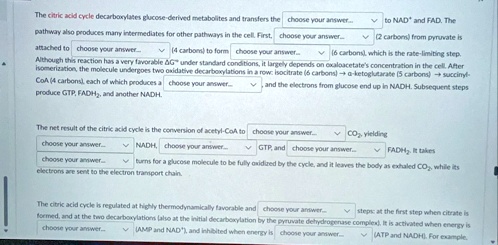
The citric acid cycle decarboxylates glucose-derived metabolites and transfers the choose your answer... to NAD+ and FAD. The pathway also produces many intermediates for other pathways in the cell. First, choose your answer... (2 carbons) from pyruvate is attached to choose your answer... (4 carbons) to form choose your answer... (6 carbons), which is the rate-limiting step. Although this reaction has a very favorable $\Delta G^{\circ}$ under standard conditions, it largely depends on oxaloacetate's concentration in the cell. After isomerization, the molecule undergoes two oxidative decarboxylations in a row: isocitrate (6 carbons) $\rightarrow$ $\alpha$-ketoglutarate (5 carbons) $\rightarrow$ succinyl-CoA (4 carbons), each of which produces a choose your answer... and the electrons from glucose end up in NADH. Subsequent steps produce GTP, FADH$_2$, and another NADH.
The net result of the citric acid cycle is the conversion of acetyl-CoA to choose your answer... CO$_2$, yielding choose your answer... NADH, choose your answer... GTP, and choose your answer... FADH$_2$. It takes choose your answer... turns for a glucose molecule to be fully oxidized by the cycle, and it leaves the body as exhaled CO$_2$, while its electrons are sent to the electron transport chain.
The citric acid cycle is regulated at highly thermodynamically favorable and choose your answer... steps: at the first step when citrate is formed, and at the two decarboxylations (also at the initial decarboxylation by the pyruvate dehydrogenase complex). It is activated when energy is choose your answer... (AMP and NAD+), and inhibited when energy is choose your answer... (ATP and NADH). For example,