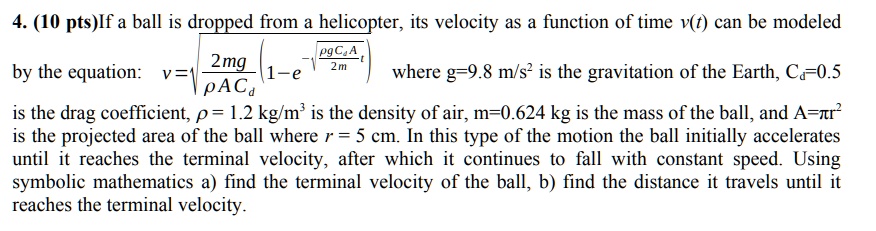
4. (10 pts)If a ball is dropped from a helicopter, its velocity as a function of time $v(t)$ can be modeled by the equation:
$v = \sqrt{\frac{2mg}{\rho A C_d}}(1 - e^{-\sqrt{\frac{\rho g C_d A}{2m}}t})$
where $g = 9.8 \, m/s^2$ is the gravitation of the Earth, $C_d = 0.5$ is the drag coefficient, $\rho = 1.2 \, kg/m^3$ is the density of air, $m = 0.624 \, kg$ is the mass of the ball, and $A = \pi r^2$ is the projected area of the ball where $r = 5 \, cm$. In this type of the motion the ball initially accelerates until it reaches the terminal velocity, after which it continues to fall with constant speed. Using symbolic mathematics a) find the terminal velocity of the ball, b) find the distance it travels until it reaches the terminal velocity.