CASE 1 Managing Motivation in a Difficult Economy 691
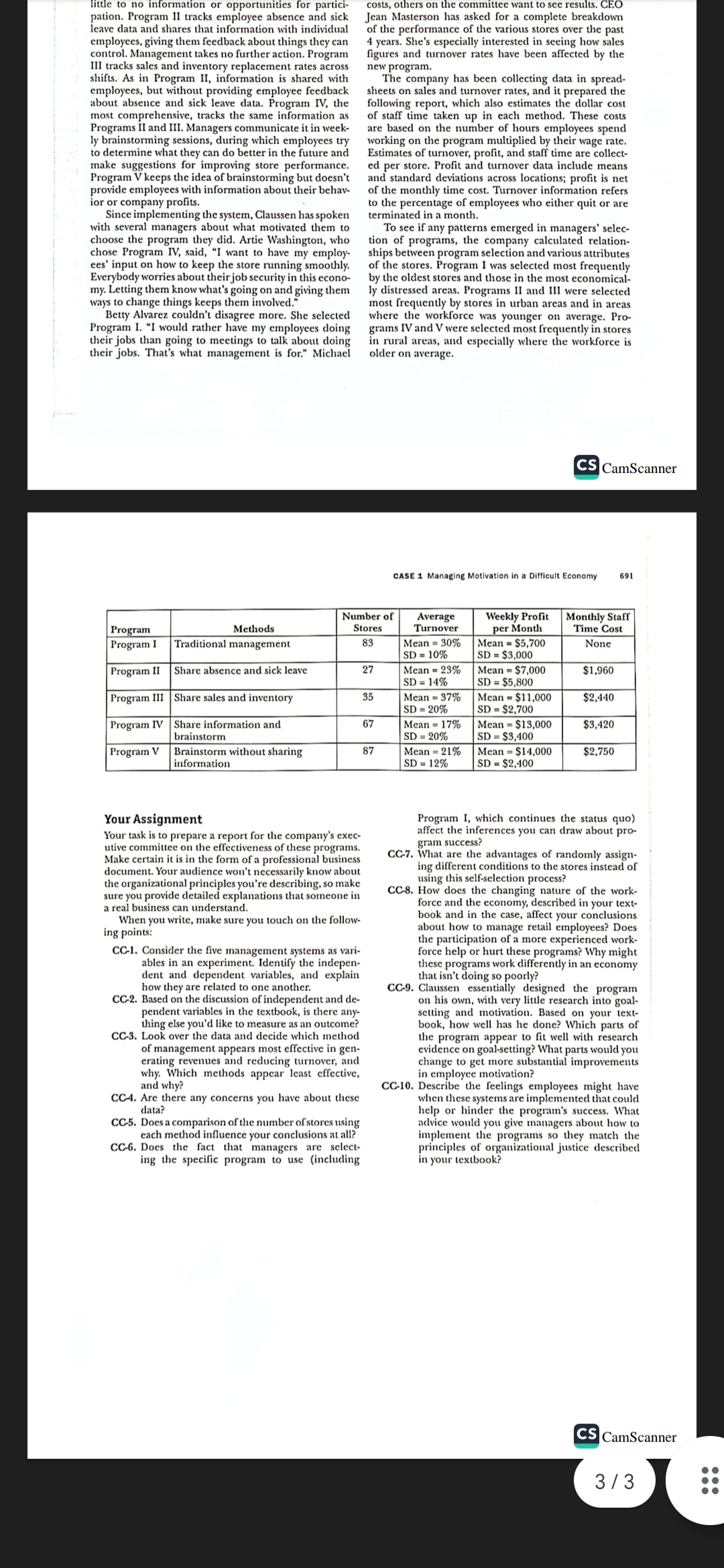
Program Methods Number of Stores Average Turnover Weekly Profit per Month Monthly Staff Time Cost
Program I Traditional management 83 Mean = 30% SD = 10% Mean = $5,700 SD = $3,000 None
Program II Share absence and sick leave 27 Mean = 23% SD = 14% Mean = $7,000 SD = $5,800 $1,960
Program III Share sales and inventory 35 Mean = 37% SD = 20% Mean = $11,000 SD = $2,700 $2,440
Program IV Share information and brainstorm 67 Mean = 17% SD = 20% Mean = $13,000 SD = $3,400 $3,420
Program V Brainstorm without sharing information 87 Mean = 21% SD = 12% Mean = $14,000 SD = $2,400 $2,750
Your Assignment
Your task is to prepare a report for the company's executive committee on the effectiveness of these programs. Make certain it is in the form of a professional business document. Your audience won't necessarily know about the organizational principles you're describing, so make sure you provide detailed explanations that someone in a real business can understand.
When you write, make sure you touch on the following points:
CC-1. Consider the five management systems as variables in an experiment. Identify the independent and dependent variables, and explain how they are related to one another.
CC-2. Based on the discussion of independent and dependent variables in the textbook, is there anything else you'd like to measure as an outcome?
CC-3. Look over the data and decide which method of management appears most effective in generating revenues and reducing turnover, and why. Which methods appear least effective, and why?
CC-4. Are there any concerns you have about these data?
CC-5. Does a comparison of the number of stores using each method influence your conclusions at all?
CC-6. Does the fact that managers are selecting the specific program to use (including Program I, which continues the status quo) affect the inferences you can draw about program success?
CC-7. What are the advantages of randomly assigning different conditions to the stores instead of using this self-selection process?
CC-8. How does the changing nature of the workforce and the economy, described in your textbook and in the case, affect your conclusions about how to manage retail employees? Does the participation of a more experienced workforce help or hurt these programs? Why might these programs work differently in an economy that isn't doing so poorly?
CC-9. Claussen essentially designed the program on his own, with very little research into goalsetting and motivation. Based on your textbook, how well has he done? Which parts of the program appear to fit well with research evidence on goal-setting? What parts would you change to get more substantial improvements in employee motivation?
CC-10. Describe the feelings employees might have when these systems are implemented that could help or hinder the program's success. What advice would you give managers about how to implement the programs so they match the principles of organizational justice described in your textbook?