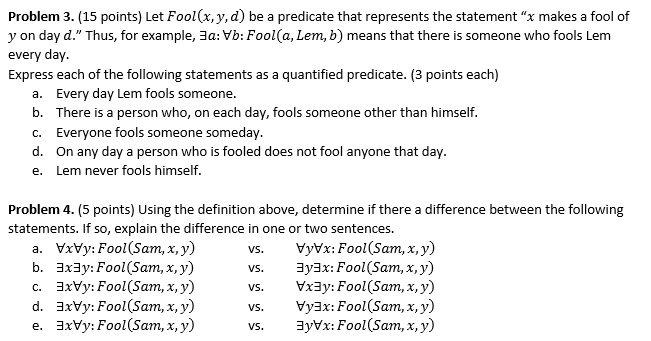
Problem 3. (15 points) Let Fool(x, y, d) be a predicate that represents the statement "x makes a fool of
y on day d." Thus, for example, $\exists a: \forall b: Fool(a, Lem, b)$ means that there is someone who fools Lem
every day.
Express each of the following statements as a quantified predicate. (3 points each)
a. Every day Lem fools someone.
b. There is a person who, on each day, fools someone other than himself.
c. Everyone fools someone someday.
d. On any day a person who is fooled does not fool anyone that day.
e. Lem never fools himself.
Problem 4. (5 points) Using the definition above, determine if there a difference between the following
statements. If so, explain the difference in one or two sentences.
a. $\forall x \forall y: Fool(Sam, x, y)$ vs. $\forall y \forall x: Fool(Sam, x, y)$
b. $\exists x \exists y: Fool(Sam, x, y)$ vs. $\exists y \exists x: Fool(Sam, x, y)$
c. $\exists x \forall y: Fool(Sam, x, y)$ vs. $\forall x \exists y: Fool(Sam, x, y)$
d. $\exists x \forall y: Fool(Sam, x, y)$ vs. $\forall y \exists x: Fool(Sam, x, y)$
e. $\exists x \forall y: Fool(Sam, x, y)$ vs. $\exists y \forall x: Fool(Sam, x, y)$