EXERCISE 5.
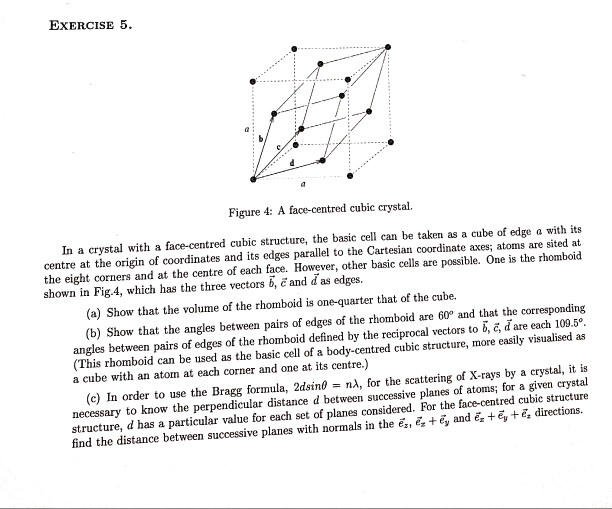
Figure 4: A face-centred cubic crystal.
In a crystal with a face-centred cubic structure, the basic cell can be taken as a cube of edge $a$ with its
centre at the origin of coordinates and its edges parallel to the Cartesian coordinate axes; atoms are sited at
the eight corners and at the centre of each face. However, other basic cells are possible. One is the rhomboid
shown in Fig.4, which has the three vectors $\vec{b}$, $\vec{c}$ and $\vec{d}$ as edges.
(a) Show that the volume of the rhomboid is one-quarter that of the cube.
(b) Show that the angles between pairs of edges of the rhomboid are 60° and that the corresponding
angles between pairs of edges of the rhomboid defined by the reciprocal vectors to $\vec{b}$, $\vec{c}$, $\vec{d}$ are each 109.5°.
(This rhomboid can be used as the basic cell of a body-centred cubic structure, more easily visualised as
a cube with an atom at each corner and one at its centre.)
(c) In order to use the Bragg formula, $2d\sin\theta = n\lambda$, for the scattering of X-rays by a crystal, it is
necessary to know the perpendicular distance $d$ between successive planes of atoms; for a given crystal
structure, $d$ has a particular value for each set of planes considered. For the face-centred cubic structure
find the distance between successive planes with normals in the $\vec{e_z}$, $\vec{e_x} + \vec{e_y}$ and $\vec{e_x} + \vec{e_y} + \vec{e_z}$ directions.