Please explain to me. Do not skip steps. Just answer if you know about it. Graph for better understanding.
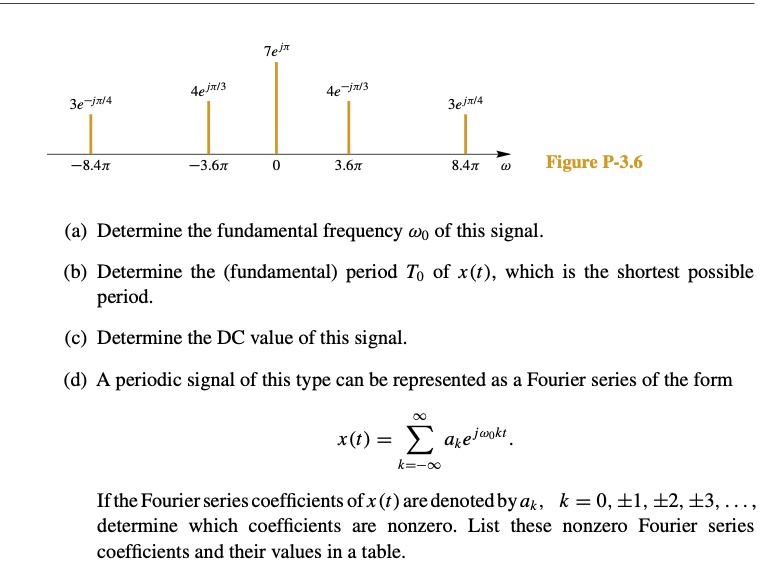
Figure P-3.6
(a) Determine the fundamental frequency ω₀ of this signal.
(b) Determine the (fundamental) period T₀ of x(t), which is the shortest possible period.
(c) Determine the DC value of this signal.
(d) A periodic signal of this type can be represented as a Fourier series of the form
x(t) = ∑[k=-∞]^[∞] aₖe^(jω₀kt).
If the Fourier series coefficients of x(t) are denoted by aₖ, k=0, ±1, ±2, ±3, ..., determine which coefficients are nonzero. List these nonzero Fourier series coefficients and their values in a table. Shown in Fig. P-3.6 is a spectrum plot for the periodic signal x(t). The frequency axis has units of rad/s.
4e^(jπ/3)
4e^(-jπ/3)
3e^(-jπ/4)
3e^(jπ/4)
8.4T
3.67t
0
3.6T
8.4T
Figure P-3.6
(a) Determine the fundamental frequency ω₀ of this signal
(b) Determine the (fundamental) period T₀ of x(t), which is the shortest possible period.
(c) Determine the DC value of this signal.
(d) A periodic signal of this type can be represented as a Fourier series of the form
x
e^(jωk)
R
If the Fourier series coefficients of x(t) are denoted by aₖ, k = 0, 1, 2, 3, .. determine which coefficients are nonzero. List these nonzero Fourier series coefficients and their values in a table.