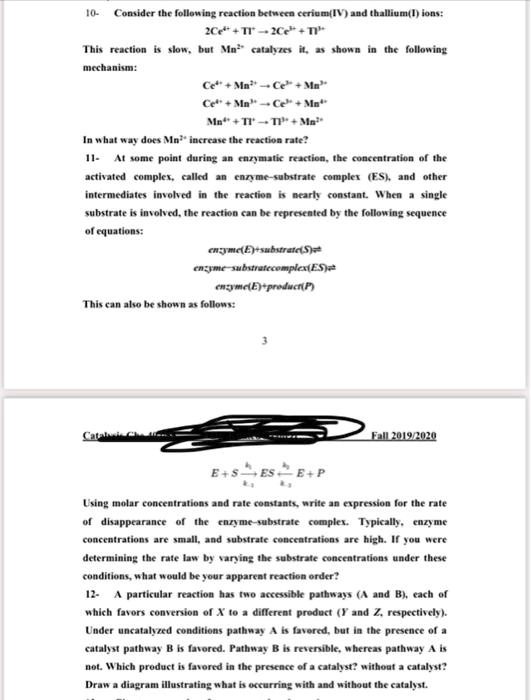
10- Consider the following reaction between cerium(IV) and thallium(I) ions: 2Ce4+ + Tl → 2Ce3+ + Tl+
This reaction is slow, but Mn catalyzes it as shown in the following mechanism:
Ce4+ + Mn → Ce3+ + Mn2+
Ce3+ + Mn → Ce4+ + Mn2+
Mn2+ + Tl → Mn + Tl+
In what way does Mn increase the reaction rate?
11- At some point during an enzymatic reaction, the concentration of the activated complex called an enzyme-substrate complex (ES), and other intermediates involved in the reaction is nearly constant. When a single substrate is involved, the reaction can be represented by the following sequence of equations:
Enzyme (E) + Substrate (S) → Enzyme-substrate complex (ES)
Enzyme (E) + Product (P)
This can also be shown as follows:
E + S → ES
E + P
Using molar concentrations and rate constants, write an expression for the rate of disappearance of the enzyme-substrate complex. Typically, enzyme concentrations are small, and substrate concentrations are high. If you were determining the rate law by varying the substrate concentrations under these conditions, what would be your apparent reaction order?
12- A particular reaction has two accessible pathways A and B, each of which favors conversion of X to a different product (Y and Z, respectively). Under uncatalyzed conditions, pathway A is favored, but in the presence of a catalyst, pathway B is favored. Pathway B is reversible, whereas pathway A is not. Which product is favored in the presence of a catalyst? Without a catalyst? Draw a diagram illustrating what is occurring with and without the catalyst.