Ace - AI Tutor
Ask Our Educators
Textbooks
My Library
Flashcards
Scribe - AI Notes
Notes & Exams
Download App
samantha reguera

samantha r.

Divider

Questions asked

BEST MATCH

5. Consider the two dimensional shape shown in the figure. (a) [5 points] Find the position of the centroid of the shape. (b) [5 points] Find the moment of inertia $I_{xx}$ about the $x$ axis. (c) [5 points] Find the moment of inertia $I_{yy}$ about the $y$ axis. $y$ 20 mm 30 mm 30 mm 42 mm 23 mm 10 mm $x$

View Answer
divider
BEST MATCH

Consider the following reaction. $$HCl$$ Part: 0/3 Part 1 of 3 Predict the major product of the given reaction. Be sure to include stereochemistry (if relevant) and only draw one product. Click and drag to start drawing a structure.

View Answer
divider
BEST MATCH

Which of the following disclosures are required by GAAP for OPEBs? a. the amounts of securities included in the plan assets b. the assumed healthcare cost trend rates c. the types of securities included in the plan assets d. All of these answer choices are required

View Answer
divider
BEST MATCH

Uncertainty Propagation through equations: Review the propagation rules and examples at the back of this handout. 1. Write the expression for either the relative uncertainty or the absolute uncertainty. (Should you start with absolute uncertainty $\delta q$, or relative uncertainty $\delta q/q$? For sum/difference, start with absolute uncertainty. For other types, find the relative uncertainty first.) F=ma m = m₁ + m₂ V=1/6πD³ q = √xy T = 2π√(1/g) L=1/2(L₁ + L₂) SF F = δη δα m a ⇒ SF = (SF/F) * F

View Answer
divider
BEST MATCH

Determine the mass percentage composition of each element 1.) A 650 g sample of compound that contains carbon, hydrogen, and oxygen otoms was and 50.5 an alyzed to contain 2579 carboon and 50.5 g hydrogen. What is the percentage composition of this compound?

View Answer
divider
BEST MATCH

Adding acetyl groups to histone lysine residues: a) has the same effect as removing phosphoryl groups. b) helps neutralize the charge of the histone. c) permanently modifies nucleosome structure. d) leads to tighter binding of DNA.

View Answer
divider
BEST MATCH

3. Goals of data analysis Consider the following scenario. An economist uses historical stock prices of a company to forecast future stock prices and determine optimal equity trading strategies. This scenario most closely aligns with which of the following goals of data analysis? Testing hypotheses Describing the economy Quantifying relationships Predicting the future

View Answer
divider
BEST MATCH

Suppose you have a random variable, X, that can take on any real number between 0 and 10. 1. Suppose that values between 0 and 5 occur 80% of the time and values between 6 and 12 occur 20% of the time. Suppose you conduct this experiment infinitely many times and get infinitely many values of X. Create a histogram with relative frequency on the vertical axis and X on the horizontal axis. relative frequency X 12 2. Now suppose we have more detailed data available. For this same random variable X, we know that values between 0 and 3 occur 30% of the time, values between 3 and 6 occur 50% of the time, values between 6 and 9 occur 15% of the time, and values between 9 and 12 occur 5% of the time. Create another histogram below. 0 02 relative frequency

View Answer
divider
BEST MATCH

QUESTION 6 How many signals would you expect in the 1H NMR spectrum of 1,4-diethoxybenzene shown below? What ratio of peak areas would you expect on integration of the spectrum? Refer to Table 13.3 for approximate chemical shifts, and sketch what the spectrum would look like (Textbook problem 13-8). OCH$_2$CH$_3$ OCH$_2$CH$_3$ Number of signals in the 1H NMR spectrum is Approximate chemical shifts from lowest to hightest: (please enter numbers to one decimal place) The ratio of peak areas on integration of the spectrum (from lowest chemical shift to highest): (please enter lowest whole number ratio)

View Answer
divider
BEST MATCH

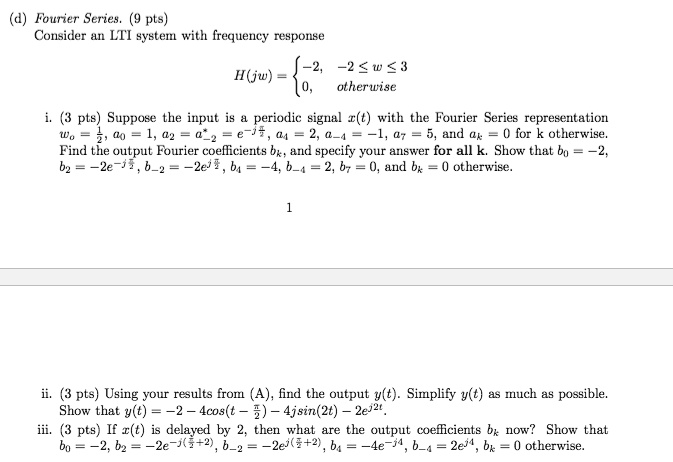
(d) Fourier Series. (9 pts) Consider an LTI system with frequency response \begin{equation*} H(j\omega) = \begin{cases} -2, & -2 \le \omega \le 3 \\ 0, & \text{otherwise} \end{cases} \end{equation*} i. (3 pts) Suppose the input is a periodic signal $x(t)$ with the Fourier Series representation $\omega_0 = \frac{1}{2}$, $a_0 = 1$, $a_2 = a_{-2} = e^{-j\frac{\pi}{2}}$, $a_4 = 2$, $a_{-4} = 1$, $a_7 = 5$, and $a_k = 0$ for $k$ otherwise. Find the output Fourier coefficients $b_k$, and specify your answer for all $k$. Show that $b_0 = -2$, $b_2 = -2e^{-j\frac{\pi}{2}}$, $b_{-2} = -2e^{j\frac{\pi}{2}}$, $b_4 = -4$, $b_{-4} = 2$, $b_7 = 0$, and $b_k = 0$ otherwise. 1 ii. (3 pts) Using your results from (A), find the output $y(t)$. Simplify $y(t)$ as much as possible. Show that $y(t) = -2 - 4cos(t - \frac{\pi}{2}) - 4jsin(2t) - 2e^{j2t}$. iii. (3 pts) If $x(t)$ is delayed by 2, then what are the output coefficients $b_k$ now? Show that $b_0 = -2$, $b_2 = -2e^{-j(\frac{\pi}{2} + 2)}$, $b_{-2} = -2e^{j(\frac{\pi}{2} + 2)}$, $b_4 = -4e^{-j4}$, $b_{-4} = 2e^{j4}$, $b_k = 0$ otherwise.
View Answer
divider