transactions.
Sept 1 Direct materials costing $60,000 were
purchased on account.
3 Direct materials costing $32,850 were requested into production (all were used on Job A).
4 Indirect materials were purchased for cash, $32,830.
8 The company issued checks for the following factory overhead costs: Utilities, $3,210; manufacturing insurance, $4,025; and repairs, $4,640
10 Direct materials costing $34,510 (all used on Job A) and indirect materials costing $6,480 were requested into production.
15 Recorded the following gross wages and salaries for employees: direct labor, $69,200 (all for Job A); indirect labor, $21,610; manufacturing supervision, $36,900; and sales commissions, $22,980.
_(15) Overhead was applied to production.
_(22) The company issued checks for the following factory overhead costs: utilities, $4,270; maintenance, $3,380; and rent, $3,250.
_(23) Direct materials costing $41,940 and indirect materials costing $8,260 were purchased.
27 Production requisitioned $28,870 of direct materials (Job A, $2,660; Job B, $8,400; Job C, $17,810) and $7,640 of indirect materials.
30 Recorded the following gross wages and salaries for employees: direct labor, $64,220 (Job A, $44,000; Job B, $9,000; Job C, $11,220); indirect labor, $30,290; manufacturing supervision, $28,520; and sales commissions, $36,200.
_(30) Manufacturing overhead was applied to production. _(30) Jobs A (58,840 units) and B (3,525 units) were completed and transferred to finished goods inventory. (Compute unit cost for each job; round to nearest cent).
_(30) Job A was shipped to the customer and the customer was billed for the sale. It is Dindi's practice to charge 40% over cost of production to allow adequate gross profit to cover period costs and profit. The company uses a perpetual inventory system.
_(30) Adjusting entries for the following were recorded: $4,680 for depreciation, factory equipment; $5,230 for property taxes for factory, payable at month end.
Manufacturing overhead is applied at a rate of 125 percent of direct labor cost.
transactions.
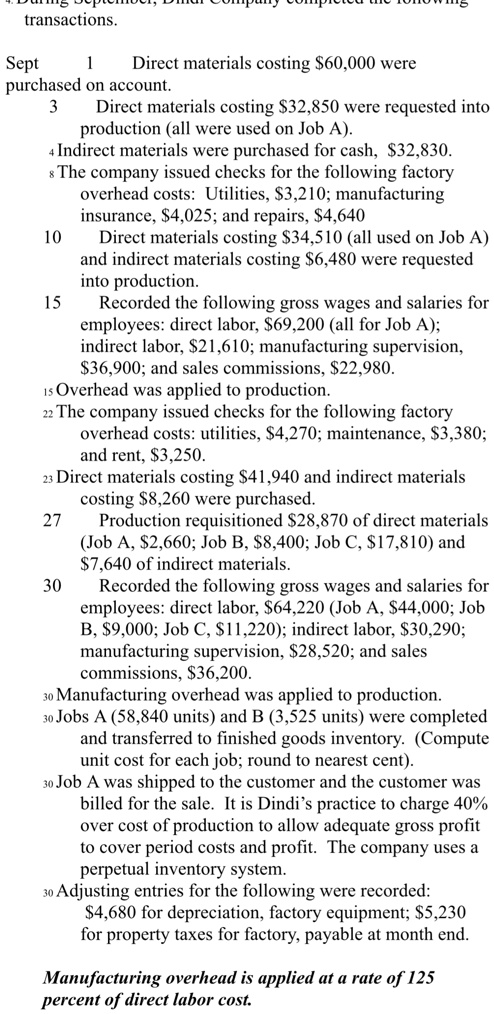
Sept 1 Direct materials costing $60,000 were purchased on account. 3 Direct materials costing $32,850 were requested into production (all were used on Job A) 4 Indirect materials were purchased for cash, $32,830. s The company issued checks for the following factory overhead costs: Utilities, $3,210; manufacturing insurance, $4,025; and repairs, $4,640 10 Direct materials costing $34,510 (all used on Job A and indirect materials costing $6,480 were requested into production. 15 Recorded the following gross wages and salaries for employees: direct labor, $69,200 (all for Job A); indirect labor, $21,610; manufacturing supervision, $36,900; and sales commissions, $22,980 1s Overhead was applied to production. 22 The company issued checks for the following factory overhead costs: utilities, $4,270; maintenance, $3,380 and rent,$3,250 2Direct materials costing $41,940 and indirect materials costing $8,260 were purchased. 27 Production requisitioned $28,870 of direct materials (Job A,$2,660; Job B,$8,400; Job C,$17,810) and $7,640 of indirect materials. 30 Recorded the following gross wages and salaries for employees: direct labor, $64,220 (Job A, $44,000; Job B,$9,000;Job C,$11,220); indirect labor,$30,290 manufacturing supervision,$28,520;and sales commissions,$36.200. 3o Manufacturing overhead was applied to production 3o Jobs A (58,840 units) and B (3,525 units) were completed and transferred to finished goods inventory. (Compute unit cost for each job; round to nearest cent). 3o Job A was shipped to the customer and the customer was billed for the sale. It is Dindi's practice to charge 40% over cost of production to allow adequate gross profit to cover period costs and profit. The company uses a perpetual inventory system. 3o Adjusting entries for the following were recorded: $4,680 for depreciation, factory equipment; $5,230 for property taxes for factory, payable at month end
Manufacturing overhead is applied at a rate of 125 percent of direct labor cost.