A flat square loop of side L is made of thin insulating fiber; the fiber carries a uniform charge density λ. Choose the x and y axes parallel to the sides of the square, and the z-axis perpendicular to the plane of the square, so that the center of the square has coordinates x=0, y=0, z=0.
(a) Find q, the total charge on the fiber.
(b) Use the result of Example 2.2 to find the electric field E(z) on the z-axis, at a point distance |z| from the center of the square loop. Can you write one formula good for both positive and negative z?
(c) Use Taylor series expansion to find a simplified expression for the electric field far away from the square when |z| >> L. Compare the answer with that obtained in the same limit in Example 2.2. Is the answer consistent with the expectation?
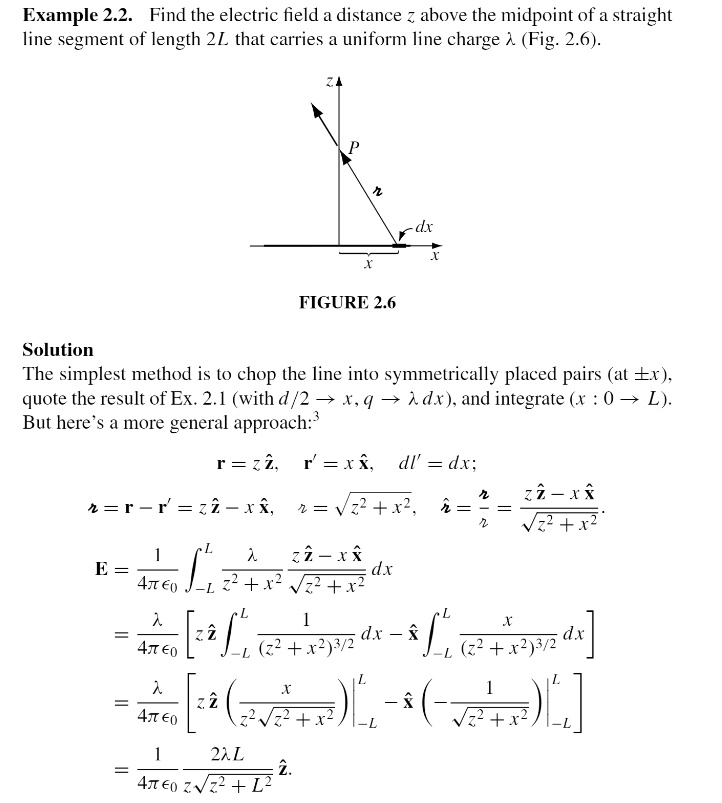
Example 2.2. Find the electric field a distance z above the midpoint of a straight line segment of length 2L that carries a uniform line charge (Fig. 2.6).
FIGURE 2.6
Solution: The simplest method is to chop the line into symmetrically placed pairs (at x), quote the result of Ex. 2.1 (with d/2 -> x, q > dx), and integrate (x: 0 -> L). But here's a more general approach:
r = z^2 + x^2
r' = x
dl' = dx
z^2 - x^2
r = √(z^2 + x^2)
z^2 - x^2
F
4πε₀
4πε₀
4πε₀
2xL
460