Ace - AI Tutor
Ask Our Educators
Textbooks
My Library
Flashcards
Scribe - AI Notes
Notes & Exams
Download App
samuel jones

samuel j.

Divider

Questions asked

BEST MATCH

Operant conditioning Latent learning Social learning Hint: Sections 7.6.2 and 7.11 [Choose] [Choose] Focus upon consequences of behavior Knowledge is acquired by observing the behavior of others Knowledge is acquired, although that knowledge is not demonstrated by the learner until they have incentive [Choose]

View Answer
divider
BEST MATCH

Starting with one cell, how many cells are present at the end of meiosis 2?

View Answer
divider
BEST MATCH

The dilation of a blood vessel supplying the brain is known as: Group of answer choices cerebral atherosclerosis cerebral embolism cerebral thrombosis cerebral aneurysm

View Answer
divider
BEST MATCH

Did Bill's utility increase or decrease between week 1 and week 2? Bill's utility between week 1 and week 2 A. decreases because in week 2 the price of good X increases but Bill's income did not change. B. decreases because in week 2 he consumes less of both goods. C. decreases because in week 2 his income decreases. D. both A and B are correct. E. all of the above. Did Bill's utility increase or decrease between week 1 and week 3? Bill's utility between week 1 and week 3 A. decreases because in week 3 Bill consumes less of both goods. B. increases because Bill's increase in income is more than enough to purchase Selected:

View Answer
divider
BEST MATCH

In the TV show Dexter, the character Dexter Morgan is a serial killer who murders killers and “guilty” people. He lacks empathy and the ability to understand the pain of other people. This behavior came about because he witnessed his mother’s murder at a young age. According to lecture, how would you characterize this person? Group of answer choices Dyssocial Psychopath Anti-Social Personality Disorder Primary Psychopath Secondary Psychopath Dissconciliatory Psychopath

View Answer
divider
BEST MATCH

Consider the following equation: \frac{6}{5x} - \frac{3}{8} = \frac{1}{4x} Step 1 of 2: State any restriction(s) on the variable, if they exist.

View Answer
divider
BEST MATCH

5.26 Mouse in a maze [Problem adapted from Sheldon Ross.] A mouse is trapped in a maze. Initially it has to choose one of two directions. If it goes to the right, then it will wander around in the maze for three minutes and will then return to its initial position. If it goes to the left, then with probability $\frac{1}{3}$ it will depart the maze after two minutes of traveling, and with probability $\frac{2}{3}$ it will return to its initial position after five minutes. The mouse is at all times equally likely to go to the left or the right. Let $T$ denote the number of minutes that it will be trapped in the maze. (a) What is E[$T$]? (b) What is Var($T$)?

View Answer
divider
BEST MATCH

Consider the below code snippet. class Book (private: string title; string ISBN;); // line1 int x = 8; int y = x+2-10; cout<<x/y<<endl; // line2 int y = 100; int z = y = ++10; // line3 int a = 10; int b; b == a; //line4 for (int j = 0; j <= 5; j++); cout << "printing..." << endl; } // line5 Which statements have logical errors in the given code?

View Answer
divider
BEST MATCH

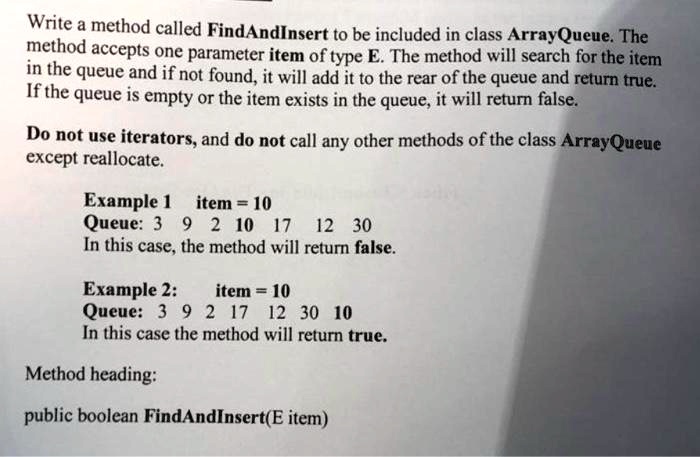
Write a method called FindAndInsert to be included in class ArrayQueue. The method accepts one parameter item of type E. The method will search for the item in the queue and if not found, it will add it to the rear of the queue and return true. If the queue is empty or the item exists in the queue, it will return false. Do not use iterators, and do not call any other methods of the class ArrayQueue except reallocate. Example 1 item = 10 Queue: 3 9 2 10 17 12 30 In this case, the method will return false. Example 2: item = 10 Queue: 3 9 2 17 12 30 10 In this case the method will return true. Method heading: public boolean FindAndInsert(E item)
View Answer
divider
BEST MATCH

a) \lim_{x \to 4} f(x) f) \lim_{x \to 5^-} f(x) b) \lim_{x \to -\infty} f(x) g) \lim_{x \to 5^+} f(x) c) f(2) h) \lim_{x \to 0} f(x) d) f(4) i) \lim_{x \to 5} f(x) e) f(5) j) \lim_{x \to \infty} f(x)

View Answer
divider