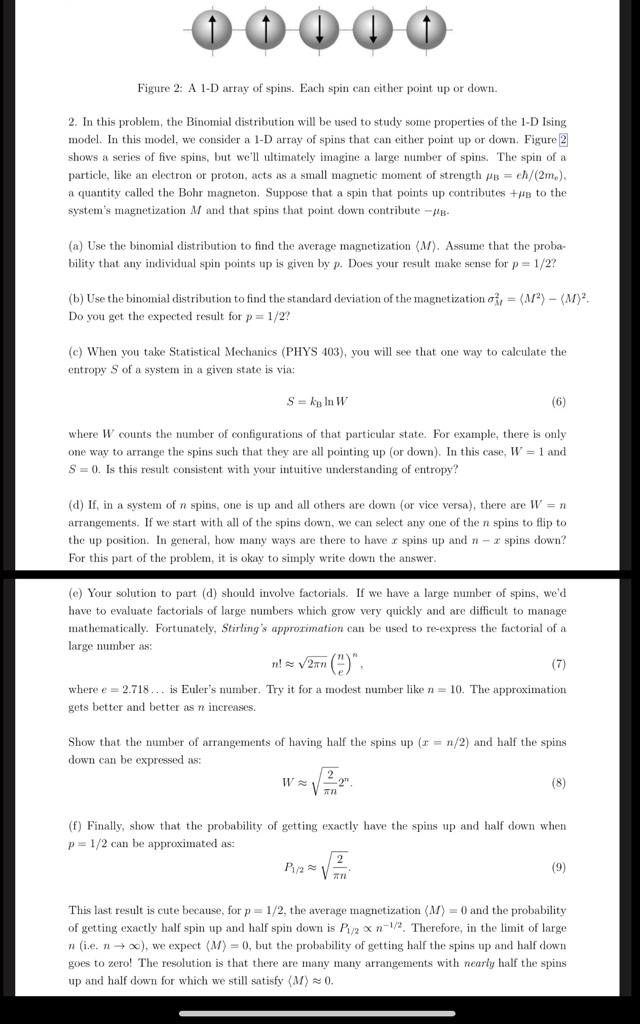
Figure 2: A 1-D array of spins. Each spin can either point up or down.
2. In this problem, the Binomial distribution will be used to study some properties of the 1-D Ising
model. In this model, we consider a 1-D array of spins that can either point up or down. Figure 2
shows a series of five spins, but we'll ultimately imagine a large number of spins. The spin of a
particle, like an electron or proton, acts as a small magnetic moment of strength $\mu_B = eh/(2m_e)$,
a quantity called the Bohr magneton. Suppose that a spin that points up contributes $+\mu_B$ to the
system's magnetization $M$ and that spins that point down contribute $-\mu_B$.
(a) Use the binomial distribution to find the average magnetization $\langle M \rangle$. Assume that the proba-
bility that any individual spin points up is given by $p$. Does your result make sense for $p = 1/2$?
(b) Use the binomial distribution to find the standard deviation of the magnetization $\sigma_M^2 = \langle M^2 \rangle - \langle M \rangle^2$.
Do you get the expected result for $p = 1/2$?
(c) When you take Statistical Mechanics (PHYS 403), you will see that one way to calculate the
entropy $S$ of a system in a given state is via:
$$S = k_B \ln W$$ (6)
where $W$ counts the number of configurations of that particular state. For example, there is only
one way to arrange the spins such that they are all pointing up (or down). In this case, $W = 1$ and
$S = 0$. Is this result consistent with your intuitive understanding of entropy?
(d) If, in a system of $n$ spins, one is up and all others are down (or vice versa), there are $W = n$
arrangements. If we start with all of the spins down, we can select any one of the $n$ spins to flip to
the up position. In general, how many ways are there to have $x$ spins up and $n-x$ spins down?
For this part of the problem, it is okay to simply write down the answer.
(e) Your solution to part (d) should involve factorials. If we have a large number of spins, we'd
have to evaluate factorials of large numbers which grow very quickly and are difficult to manage
mathematically. Fortunately, Stirling's approximation can be used to re-express the factorial of a
large number as:
$$n! \approx \sqrt{2\pi n} \left( \frac{n}{e} \right)^n,$$ (7)
where $e = 2.718...$ is Euler's number. Try it for a modest number like $n = 10$. The approximation
gets better and better as $n$ increases.
Show that the number of arrangements of having half the spins up ($x = n/2$) and half the spins
down can be expressed as:
$$W \approx \sqrt{\frac{2}{\pi n}} 2^n.$$ (8)
(f) Finally, show that the probability of getting exactly have the spins up and half down when
$p = 1/2$ can be approximated as:
$$P_{1/2} \approx \sqrt{\frac{2}{\pi n}}.$$ (9)
This last result is cute because, for $p = 1/2$, the average magnetization $\langle M \rangle = 0$ and the probability
of getting exactly half spin up and half spin down is $P_{1/2} \propto n^{-1/2}$. Therefore, in the limit of large
$n$ (i.e. $n \to \infty$), we expect $\langle M \rangle = 0$, but the probability of getting half the spins up and half down
goes to zero! The resolution is that there are many many arrangements with nearly half the spins
up and half down for which we still satisfy $\langle M \rangle \approx 0$.