Ace - AI Tutor
Ask Our Educators
Textbooks
My Library
Flashcards
Scribe - AI Notes
Notes & Exams
Download App
samuel montero

samuel m.

Divider

Questions asked

BEST MATCH

A. Standardization of NaOH Solution: | | Sample A | Sample B | Sample C | |---|---|---|---| | 1. Molarity of Standard HCl | 0.09800 M | 0.09800 M | 0.09800 M | | 2. Volume of Standard HCl used | 25.0 mL | 25.0 mL | 25.0 mL | | 3. Initial Volume NaOH solution | 49.25 mL | 31.85 mL | 37.00 mL | | 4. Final Volume NaOH solution | 31.85 mL | 13.50 mL | 18.35 mL | | 5. Volume of NaOH solution used | 17.40 mL | 18.35 mL | 18.65 mL | | 6. Molarity of NaOH solution | 0.1410 M | 0.1331 M | 0.1315 M | | 7. Average Molarity of NaOH solution | | 0.1352 M | | B. Titration of Vinegar Solution: | | Sample A | Sample B | Sample C | |---|---|---|---| | 8. Molarity of NaOH solution (average from part A) | 0.1352 M | 0.1352 M | 0.1352 M | | 9. Initial Volume NaOH solution | 50.00 mL | 50.00 mL | 50.00 mL | | 10. Final Volume NaOH solution | 14.55 mL | 20.28 mL | 41.25 mL | | 11. Volume of NaOH solution used | 35.45 mL | 29.72 mL | 9.00 mL | | 12. Volume of Vinegar used | 25.00 mL | 25.00 mL | 25.00 mL | | 13. Molarity of $HC_2H_3O_2$ in Vinegar | 0.1916 M | | | | 14. Average Molarity of $HC_2H_3O_2$ in Vinegar | | | |

View Answer
divider
BEST MATCH

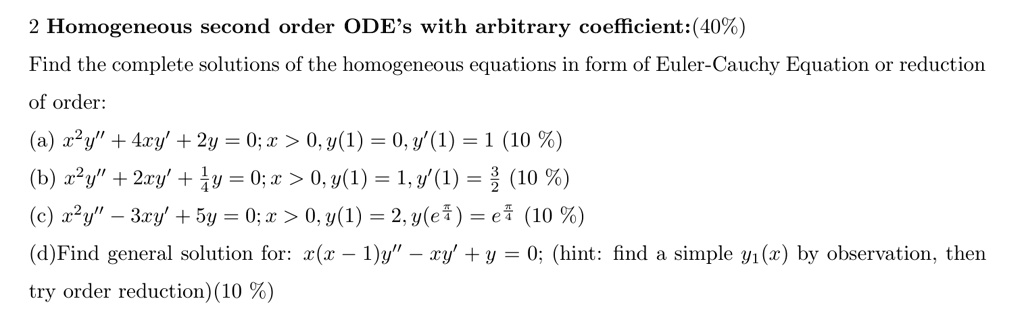
2 Homogeneous second order ODE's with arbitrary coefficient: (40%) Find the complete solutions of the homogeneous equations in form of Euler-Cauchy Equation or reduction of order: (a) $x^2y'' + 4xy' + 2y = 0$; $x > 0$, $y(1) = 0$, $y'(1) = 1$ (10%) (b) $x^2y'' + 2xy' + \frac{1}{4}y = 0$; $x > 0$, $y(1) = 1$, $y'(1) = \frac{3}{2}$ (10%) (c) $x^2y'' - 3xy' + 5y = 0$; $x > 0$, $y(1) = 2$, $y(e^{\frac{\pi}{2}}) = e^{\frac{\pi}{2}}$ (10%) (d) Find general solution for: $x(x-1)y'' - xy' + y = 0$; (hint: find a simple $y_1(x)$ by observation, then try order reduction) (10%)
View Answer
divider
BEST MATCH

A particle moves along the x-axis with an acceleration of $a(t) = 12t - 4$. The particle's velocity is 18 centimeters per second at $t = 2$. The initial position of the particle is 8 cm. What is the position of the particle at $t = 3$?

View Answer
divider
BEST MATCH

Step 1 Step 2

View Answer
divider
BEST MATCH

CE 3221 Fluid Mechanics Partially Submerged Objects Name 2. A rectangular barge is loaded with wheat. The barge is 28 ft wide, 90 ft long, and displaces a depth of water of 5 ft when empty. When loaded with wheat, the barge displaces a depth of water of 7 ft. Calculate the weight of the barge and the weight of the wheat. (ans: 786,000 lb, 315,000 lb)

View Answer
divider
BEST MATCH

Worth 5 points Question 4/15 Abigail is looking for her cell phone. As she looks around the room, she passively registers information about her distance from objects. This passive registration of information best fits the ____ view of perception. direct constructive interpretive abstract 1 attempt remaining Submit

View Answer
divider
BEST MATCH

? Question 14 In a program, you need to loop through a string in reverse order. Which of the following loop constructs would be best for this? while loop Range for loop do-while loop General for loop Question 15 Which of the following types would be best to represent someone's GPA? float string int array 2 pts 2 pts

View Answer
divider
BEST MATCH

Regarding an inversion ankle sprain, name the three ligaments most likely to be injured, and also the most important muscle group to strengthen in rehab as well as prevention? Ligaments: Muscle Group:

View Answer
divider
BEST MATCH

The rule of Dulong and Petit states that the molar heat capacities of the metallic elements are approximately constant. Estimate the value of this constant by calculating the molar heat capacities of the following metals from their specific heats and taking the average. Specific heat Molar heat capacity Metal J g$^{-1}$ K$^{-1}$ J mol$^{-1}$ K$^{-1}$ cadmium 0.231 zinc 0.388 iron 0.449 Average: J mol$^{-1}$ K$^{-1}$

View Answer
divider
BEST MATCH

2020 Time Left:0:52:28 Naman Jain: Attempt 1 2m 5 m 4 m 3 m A B 3 m H \theta 15 kN. D E 2 m F 2 m G \theta 66 kN. In the diagram above $\theta$ = 42.9 degrees Use Method of Joints only to determine the force in member CH Notes: Only place the numerical value in the box. Work to 2 decimal places

View Answer
divider