3. Sea Otter Food Web
Consider the following list of species and the species they feed on.
\begin{tabular}{|l|l|}
\hline Species & Species they feed on \\
\hline shark & sea otter \\
\hline sea otter & sea stars, sea urchins, large crabs, large fish and octopus, abalone \\
\hline sea stars & abalone, small herbivorous fishes, sea urchins, organic debris \\
\hline sea urchins & kelp, sessile invertebrates, organic debris \\
\hline abalone & organic debris \\
\hline large crabs & sea stars, smaller predatory fishes, organic debris, small herbivorous fishes, kelp \\
\hline smaller predatory fishes & sessile invertebrates, planktonic invertebrates \\
\hline small herbivorous fishes & kelp \\
\hline kelp & \\
\hline large fish and octopus & smaller predatory fishes, large crabs \\
\hline sessile invertebrates & microscopic planktonic algae, planktonic invertebrates \\
\hline organic debris & \\
\hline planktonic invertebrates & microscopic planktonic algae \\
\hline microscopic planktonic algae & \\
\hline
\end{tabular}
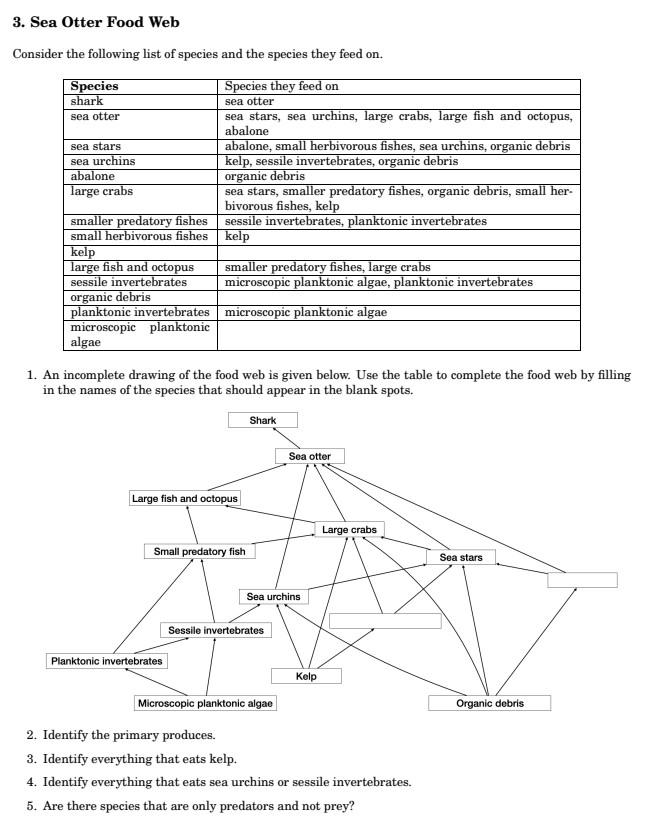
1. An incomplete drawing of the food web is given below. Use the table to complete the food web by filling in the names of the species that should appear in the blank spots.
2. Identify the primary produces.
3. Identify everything that eats kelp.
4. Identify everything that eats sea urchins or sessile invertebrates.
5. Are there species that are only predators and not prey?