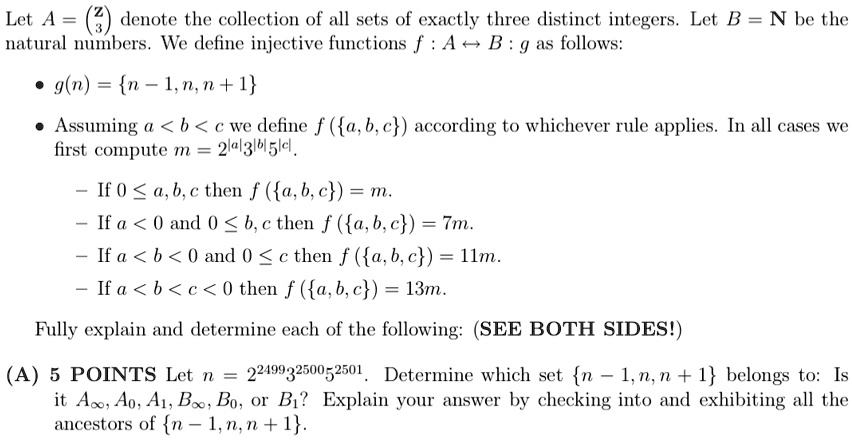
Let A = \(\binom{Z}{3}\) denote the collection of all sets of exactly three distinct integers. Let B = N be the natural numbers. We define injective functions $f: A \leftrightarrow B: g$ as follows:
\begin{itemize}
\item $g(n) = \{n - 1, n, n + 1\}$
\item Assuming $a < b < c$ we define $f(\{a, b, c\})$ according to whichever rule applies. In all cases we first compute $m = 2^{|a|}3^{|b|}5^{|c|}.$
\begin{itemize}
\item If $0 \le a, b, c$ then $f(\{a, b, c\}) = m.$
\item If $a < 0$ and $0 \le b, c$ then $f(\{a, b, c\}) = 7m.$
\item If $a < b < 0$ and $0 \le c$ then $f(\{a, b, c\}) = 11m.$
\item If $a < b < c < 0$ then $f(\{a, b, c\}) = 13m.$
\end{itemize}
\end{itemize}
Fully explain and determine each of the following: (SEE BOTH SIDES!)
(A) 5 POINTS Let $n = 224993250052501$. Determine which set $\{n - 1, n, n + 1\}$ belongs to: Is it $A_\infty, A_0, A_1, B_\infty, B_0,$ or $B_1$? Explain your answer by checking into and exhibiting all the ancestors of $\{n - 1, n, n + 1\}$.