Ace - AI Tutor
Ask Our Educators
Textbooks
My Library
Flashcards
Scribe - AI Notes
Notes & Exams
Download App
sandra berry

sandra b.

Divider

Questions asked

BEST MATCH

Which of the following is most likely to be seen most commonly in the wings of a migratory bird? Slow glycolytic fibers Fast glycolytic fibers Fast oxidative fibers All of the above None of the above

View Answer
divider
BEST MATCH

. In general, sound waves travel fastest in _____. a. solids b. liquids c. gases d. vacuum 2. Sammy is talking to Sally. Position A is a position in front of Sammy's mouth. Position B is a position in front of Sally's ear. In order for Sally to hear Sammy's voice, air particles must ____. a. move from A to B b. move from A to B and then back to A c. vibrate parallel to a line connecting A and B d. vibrate perpendicular to a line connecting A and B

View Answer
divider
BEST MATCH

Question 1 (Mandatory) (1 point) Which of the following is NOT a muscle primarily involved in the breathing process? latissimus dorsi external intercostal internal intercostal diaphragm

View Answer
divider
BEST MATCH

In the movie when harry met sally what is the purpose of old couples story

View Answer
divider
BEST MATCH

In the Amazon, squirrel monkeys often travel with brown capuchins. The larger capuchins break nuts using their large molars. When the capuchins drop the shells, the smaller squirrel monkeys dig out any remaining nut-meat left in the shell. Since these species travel together and sleep in nearby sleeping locations every day, we might call this group which of the following? Group of answer choices A fragmented association A polyandrous group A polyspecific association A single reproductive group

View Answer
divider
BEST MATCH

How can we encourage those who don’t have the ability or the want to participate in health informatics system?

View Answer
divider
BEST MATCH

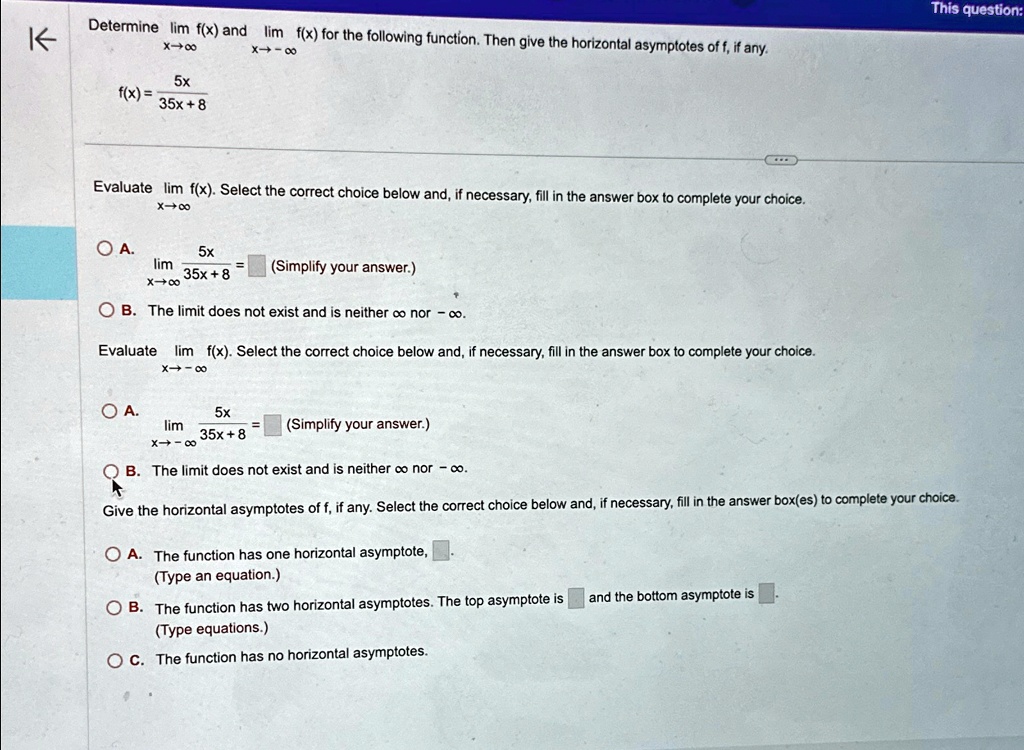
This question: Determine lim_(x->infty )f(x) and lim_(x->-infty )f(x) for the following function. Then give the horizontal asymptotes of f, if any. f(x)=(5x)/(35x+8) Evaluate lim_(x->infty )f(x). Select the correct choice below and, if necessary, fill in the answer box to complete your choice. A. lim_(x->infty )(5x)/(35x+8)= (Simplify your answer.) B. The limit does not exist and is neither infty nor -infty . Evaluate lim_(x->-infty )f(x). Select the correct choice below and, if necessary, fill in the answer box to complete your choice. A. lim_(x->-infty )(5x)/(35x+8)= (Simplify your answer.) B. The limit does not exist and is neither infty nor -infty . Give the horizontal asymptotes of f, if any. Select the correct choice below and, if necessary, fill in the answer box(es) to complete your choice. A. The function has one horizontal asymptote, (Type an equation.) B. The function has two horizontal asymptotes. The top asymptote is and the bottom asymptote is (Type equations.) C. The function has no horizontal asymptotes. This question: Determine lim f(x) and lim f(x) for the following function. Then give the horizontal asymptotes of f, if any. 8-X 5x +=(x Evaluate lim f(x). Select the correct choice below and, if necessary, fill in the answer box to complete your choice. X-0 OA. 5x Simplify your answer.) 8X O B. The limit does not exist and is neither co nor -co X- 8 OA. 5x lim 35+8 (Simplify your answer.) B. The limit does not exist and is neither co nor -co Give the horizontal asymptotes of f if any Select the correct choice below and, if necessary, fill in the answer box(es) to complete your choice. O A. The function has one horizontal asymptote, (Type an equation.) O B. The function has two horizontal asymptotes. The top asymptote is and the bottom asymptote is (Type equations.) O C. The function has no horizontal asymptotes.
View Answer
divider
BEST MATCH

Can you explain how you would use Taylor expansion to compute limits? An example is lim x->0 cubic root(1+x)-1/root 5 (1-x)-1. Is there a step-by-step method to compute any limit?

View Answer
divider
BEST MATCH

Question A pulley having 15 mm width is pressed fitted onto a uniform cross-section solid shaft. The coefficient of friction between the shaft and the pulley is 0.2. The radial interference between the shaft and the pulley is \(\delta=8\) \(\mu m\). The contact pressure between the shaft and the pulley should not exceed 120 MPa. Shaft: Material is steel having E=210 GPa, Sy=500 MPa, v=0.3. Pulley and shaft materials are the same. Take \(d_s=25\) mm, \(d_p=120\) mm, L=160 mm, \(F_1=1000\) N, \(F_2=200\) N. a) Draw the Shear Force, Bending Moment and Torque diagrams of the shaft. b) Find and clearly state the critical section(s) and the most critically stressed point on the shaft. c) Find the stress state at that critical point. Draw the stress element and show all the stress components on it in appropriate directions. d) Find the principal stresses and the greatest maximum shear stress by drawing 3-D Mohr circle. e) Find the factor of safety against slippage between the shaft and the pulley.

View Answer
divider
BEST MATCH

Problem 1 Compare the following heating processes. Are you able to predict the trends for the required amounts of heat and the respective changes in entropy? Heat n mol of liquid water at 1 bar from T1 °C to T2 °C A. How much heat is required? B. Determine the change in entropy of the liquid water. Heat n mol of water vapor from T1 °C to T2 °C at a constant pressure of 1 bar. (Note: water vapor can't be considered an ideal gas) C. How much heat is required? D. Determine the change in entropy of the water vapor. Heat n mol of an ideal polyatomic and nonlinear gas from T1 °C to T2 °C at a constant pressure of 1 bar. E. How much heat is required? F. Determine the change in entropy of the gas. Heat n mol of an ideal polyatomic and nonlinear gas from T3 °C to T4 °C at a constant pressure of 1 bar. G. How much heat is required? H. Determine the change in entropy of the gas. Problem 2 m g of CO2 are isothermally compressed at a temperature of 25 °C. The initial volume of the gas is Vini Liter and the compression is carried out until the pressure has reached Pend bar. You can consider the gas to behave as an ideal gas. I. Determine the change in internal energy of the gas. J. Determine the change in enthalpy of the gas. K. Determine the change in entropy of the gas.

View Answer
divider