2. The effect of impatience on consumer choices
Suppose the Super Bowl is this week, and Teresa is in need of a television to watch the big game. As a college student, Teresa knows that she can either buy her flat-screen television at the local electronics store, or she can shop online for a better deal but have to wait three days for the television to arrive. The following problem uses the economic concept of rate of time preference to help determine which decision is better for Teresa.
Throughout the question, assume that Teresa pays for the good the day she buys it, so her wealth is affected in the initial time period no matter where she buys the good. Also, assume the shipping cost and cost to travel to the store are incorporated into their respective given prices. Finally, assume the goods are identical, and there's no cost to gaining information about prices-in other words, she knows the best price online and in the store without having to search.
Suppose Teresa receives a utility of 173.33 utils once she actually receives her television. Let $\beta$ indicate Teresa's patience level; that is, $\beta$ represents the discount rate between consuming something today versus tomorrow.
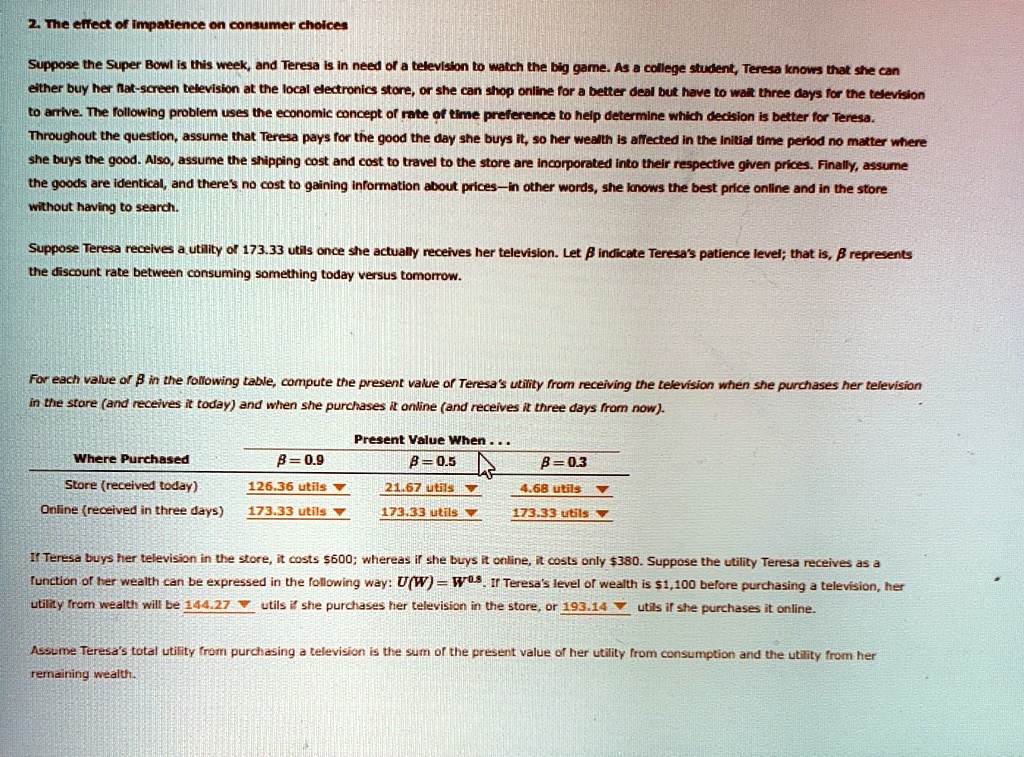
For each value of $\beta$ in the following table, compute the present value of Teresa's utility from receiving the television when she purchases her television in the store (and receives it today) and when she purchases it online (and receives it three days from now).
Where Purchased $\beta = 0.9$ Present Value When $\beta = 0.5$ $\beta = 0.3$
Store (received today) 126.36 utils 21.67 utils 4.68 utils
Online (received in three days) 173.33 utils 173.33 utils 173.33 utils
If Teresa buys her television in the store, it costs $600; whereas if she buys it online, it costs only $380. Suppose the utility Teresa receives as a function of her wealth can be expressed in the following way: $U(W) = W^{0.5}$. If Teresa's level of wealth is $1,100 before purchasing a television, her utility from wealth will be 144.27 utils if she purchases her television in the store, or 193.14 utils if she purchases it online.
Assume Teresa's total utility from purchasing a television is the sum of the present value of her utility from consumption and the utility from her remaining wealth.