Ace - AI Tutor
Ask Our Educators
Textbooks
My Library
Flashcards
Scribe - AI Notes
Notes & Exams
Download App
sandra smith

sandra s.

Divider

Questions asked

BEST MATCH

Rewrite the given equation of the quadric surface in standard form. x2 + 3y2 − 9z2 = 0

View Answer
divider
BEST MATCH

b. b_(n)=7 (-(8)/(9))^(n) b. $b_n = 7 + (-\frac{8}{9})^n$

View Answer
divider
BEST MATCH

Starting with an amount of reactant, we can calculate the amount of product that should be formed using a balanced chemical equation. In the step we change substances during the unit conversion we can use the units …

View Answer
divider
BEST MATCH

Convert 6.83e+25 molecules of CO$_2$ to grams of oxygen. Round to two decimal places, do not use scientific notation

View Answer
divider
BEST MATCH

What is the major storage form of energy in biological cells? Calories kilocalories ADP ATP

View Answer
divider
BEST MATCH

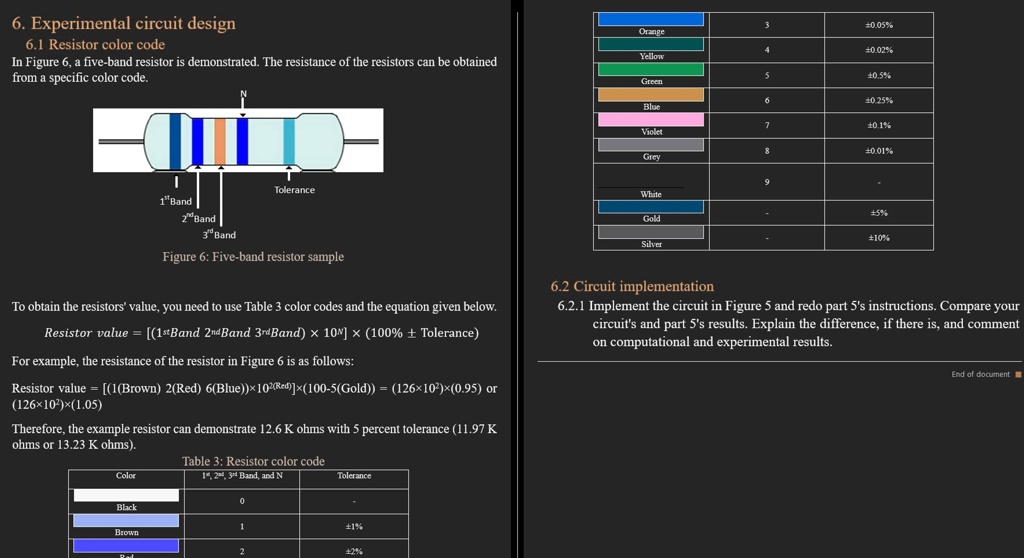
6. Experimental circuit design 6.1 Resistor color code In Figure 6, a five-band resistor is demonstrated. The resistance of the resistors can be obtained from a specific color code. 1"Band 2nd Band 3d Band Tolerance Orange ±0.05% Yellow ±0.02% Green ±0.5% Blue ±0.25% Violet ±0.1% Grey ±0.01% White Gold Silver ±5% ±10% Figure 6: Five-band resistor sample To obtain the resistors' value, you need to use Table 3 color codes and the equation given below. Resistor value = [(1stBand 2nd Band 3rd Band) × 10N] × (100% ± Tolerance) For example, the resistance of the resistor in Figure 6 is as follows: Resistor value = [(1(Brown) 2(Red) 6(Blue))×102(Red)]×(100-5(Gold)) = (126×102)×(0.95) or (126×102)×(1.05) Therefore, the example resistor can demonstrate 12.6 K ohms with 5 percent tolerance (11.97 K ohms or 13.23 K ohms). Color Table 3: Resistor color code 1, 2nd, 3rd Band, and N Tolerance 6.2 Circuit implementation 6.2.1 Implement the circuit in Figure 5 and redo part 5's instructions. Compare your circuit's and part 5's results. Explain the difference, if there is, and comment on computational and experimental results. End of document
View Answer
divider
BEST MATCH

Suppose a an advertisement for a certain drug reports the results of a double-blind study in which 387 patients took the drug and 193 took a placebo. Headaches were reported as a side effect by 74 of those taking the drug. A button hyperlink to the SALT program that reads: Use SALT. (a) What is the sample proportion of patients taking the drug who reported headaches? (Round your answer to three decimal places.) (b) What is the standard error accompanying the proportion computed in part (a)? (Round your answer to three decimal places.) (c) Construct a 95% confidence interval for the population proportion based on the information from parts (a) and (b). (Round your answers to three decimal places.)

View Answer
divider
BEST MATCH

At time t(i) , the kinetic energy of a particle is 36.5 J and its potential energy is 9.48 J. At some later time t(f), its kinetic energy is 16 J. If the potential energy at time tf is 7.78 J, what is the work done by the nonconservative forces acting on the particle? Answer in units of J.

View Answer
divider
BEST MATCH

A system using matched filter detection of equally likely BPSK signal, $S_1(t) = \sqrt{\frac{2E}{T}} \cos \omega t$ and $S_2(t) = \sqrt{\frac{2E}{T}} \cos(\omega t + \pi)$ operates in AWGN with $\frac{E_b}{N_0} = 6.8$ [dB] assuming the correlator output at optimum sampling time $T$ is $\pm \sqrt{E}$. (a) Find $P_e$ for the given $\frac{E_b}{N_0}$ (b) For the fixed T/H level of $x = 0.1\sqrt{E}$ find $P_e$ Both (a), (b), answer must be numerical values!

View Answer
divider
BEST MATCH

Let C be a locally small category with all small limits, and D: J \rightarrow C any diagram in C. Show that for any object A \in |C|, the representable functor Hom_C(C, -) preserves the limit of D.

View Answer
divider