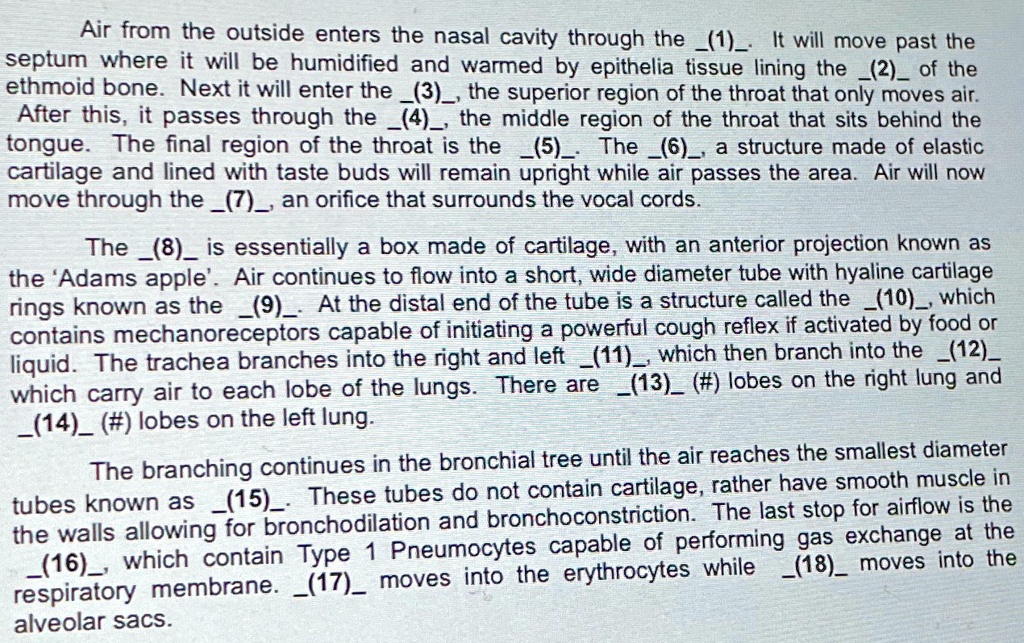
Air from the outside enters the nasal cavity through the nostrils. It will move past the septum where it will be humidified and warmed by epithelial tissue lining the cribriform plate of the ethmoid bone. Next, it will enter the nasopharynx, the superior region of the throat that only moves air. After this, it passes through the oropharynx, the middle region of the throat that sits behind the tongue. The final region of the throat is the laryngopharynx, a structure made of elastic cartilage and lined with taste buds that will remain upright while air passes the area. Air will now move through the glottis, an orifice that surrounds the vocal cords.
The larynx is essentially a box made of cartilage, with an anterior projection known as the "Adam's apple". Air continues to flow into a short, wide-diameter tube with hyaline cartilage rings known as the trachea. At the distal end of the tube is a structure called the carina, which contains mechanoreceptors capable of initiating a powerful cough reflex if activated by food or liquid. The trachea branches into the right and left primary bronchi, which then branch into the secondary bronchi that carry air to each lobe of the lungs. There are 3 lobes on the right lung and 2 lobes on the left lung. The branching continues in the bronchial tree until the air reaches the smallest diameter tubes known as bronchioles. These tubes do not contain cartilage, rather have smooth muscle in the walls allowing for bronchodilation and bronchoconstriction. The last stop for airflow is the alveoli, which contain Type 1 Pneumocytes capable of performing gas exchange at the respiratory membrane. Oxygen moves into the erythrocytes while carbon dioxide moves into the alveolar sacs.