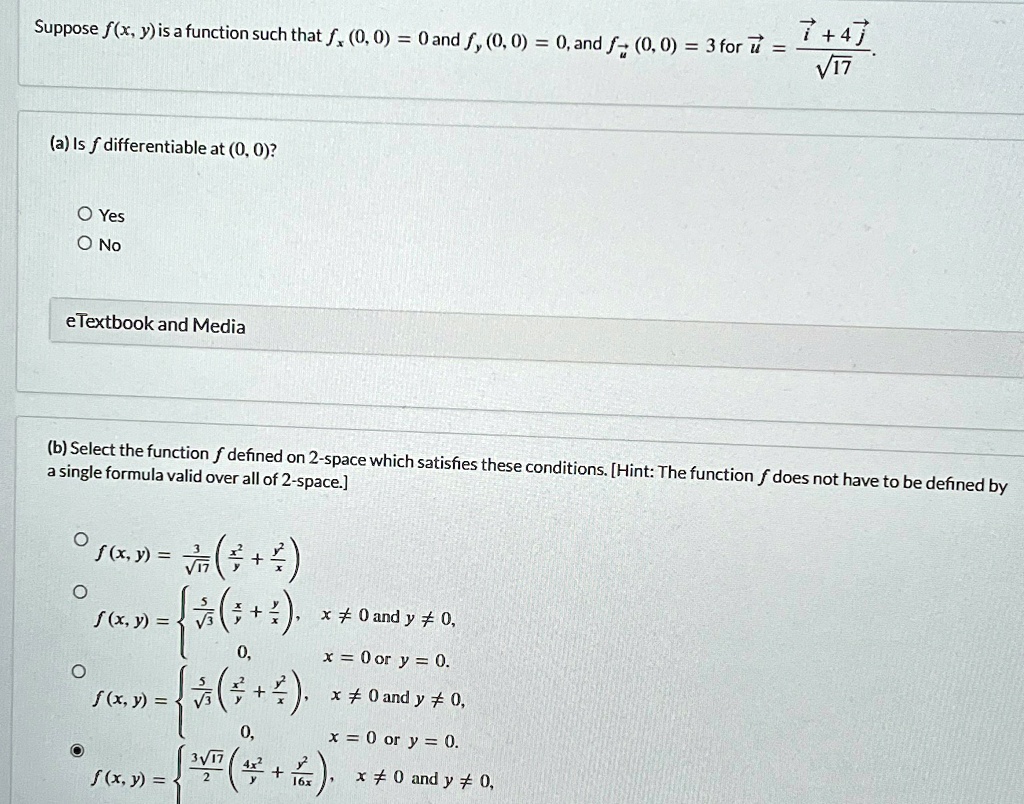
Suppose $f(x, y)$ is a function such that $f_x(0, 0) = 0$ and $f_y(0, 0) = 0$, and $f_\vec{u}(0, 0) = 3$ for $\vec{u} = \frac{\vec{i} + 4\vec{j}}{\sqrt{17}}$.
(a) Is $f$ differentiable at $(0, 0)$?
$\circ$ Yes
$\circ$ No
eTextbook and Media
(b) Select the function $f$ defined on 2-space which satisfies these conditions. [Hint: The function $f$ does not have to be defined by a single formula valid over all of 2-space.]
$\circ$ $f(x, y) = \frac{3}{\sqrt{17}} \left(\frac{x^2}{y} + \frac{y^2}{x}\right)$
$\circ$ $f(x, y) = \begin{cases} \frac{3}{\sqrt{17}} \left(\frac{x^2}{y} + \frac{y^2}{x}\right), & x \neq 0 \text{ and } y \neq 0, \\ 0, & x = 0 \text{ or } y = 0. \end{cases}$
$\circ$ $f(x, y) = \begin{cases} \frac{5}{\sqrt{13}} \left(\frac{x^2}{y} + \frac{y^2}{x}\right), & x \neq 0 \text{ and } y \neq 0, \\ 0, & x = 0 \text{ or } y = 0. \end{cases}$
$\circ$ $f(x, y) = \begin{cases} \frac{3\sqrt{17}}{2} \left(\frac{4x^2}{y} + \frac{y^2}{16x}\right), & x \neq 0 \text{ and } y \neq 0, \\ \end{cases}$