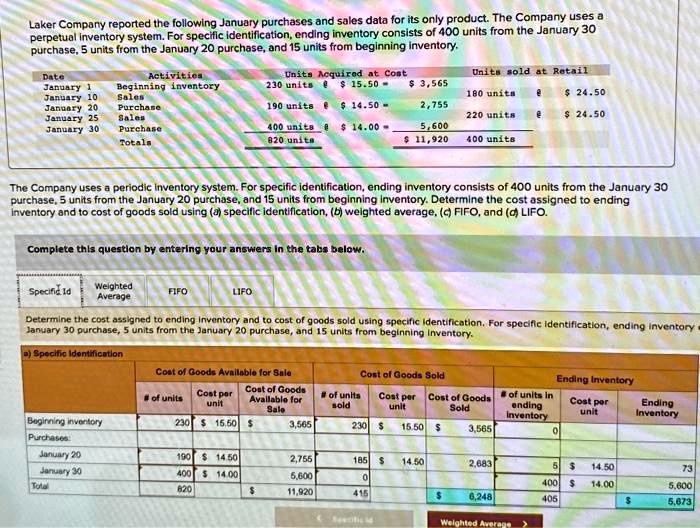
Texts: For specific ID, how are the number of units in ending inventory 0 if I got 230 of them for $15.50?
Laker Company reported the following January purchases and sales data for its only product. The Company uses a perpetual inventory system. For specific identification, ending inventory consists of 400 units from the January 30 purchase, 5 units from the January 20 purchase, and 15 units from beginning inventory.
Date Activities Units Acquired at Cost Units sold at Retail
January 1 Beginning inventory 230 units $15.50 $3,565
Sales 180 units $24.50
January 10
January 20 Purchase 190 units $14.50 $2,755
January 25 Sales 220 units $24.50
January 30 Purchase 400 units $14.00 $5,600
Totals 020 units $11,920 400 units
The Company uses a periodic inventory system. For specific identification, ending inventory consists of 400 units from the January 30 purchase, 5 units from the January 20 purchase, and 15 units from beginning inventory. Determine the cost assigned to ending inventory and to cost of goods sold using a specific identification, b weighted average, c FIFO, and d LIFO.
Complete this question by entering your answers in the tabs below.
Specific Identification
Weighted Average
FIFO
LIFO
January 30 purchase, 5 units from the January 20 purchase, and 15 units from beginning inventory
Specific identification
Cost of Goods Available for Sale
Cost of Goods Sold
Ending Inventory
Cost per unit
Cost of Goods
Number of units
Available for
Sale
Number of units
Cost per unit
Cost of Goods
Number of units
In unit sold
Ending
Inventory
Cost per
unit
Sold
Ending
Sale
inventory
Beginning inventory
230 $15.50 $3,565
230 $15.50 $3,565
0
Purchases:
January 20
190 $14.50 $2,755
185 $14.50 $2,683
January 30
5 $14.50 $400
73 $14.00 $6,600
0
Total
400 $820 $14.00 $5,600 $11,920
415 $6,248
405 3 $5,673