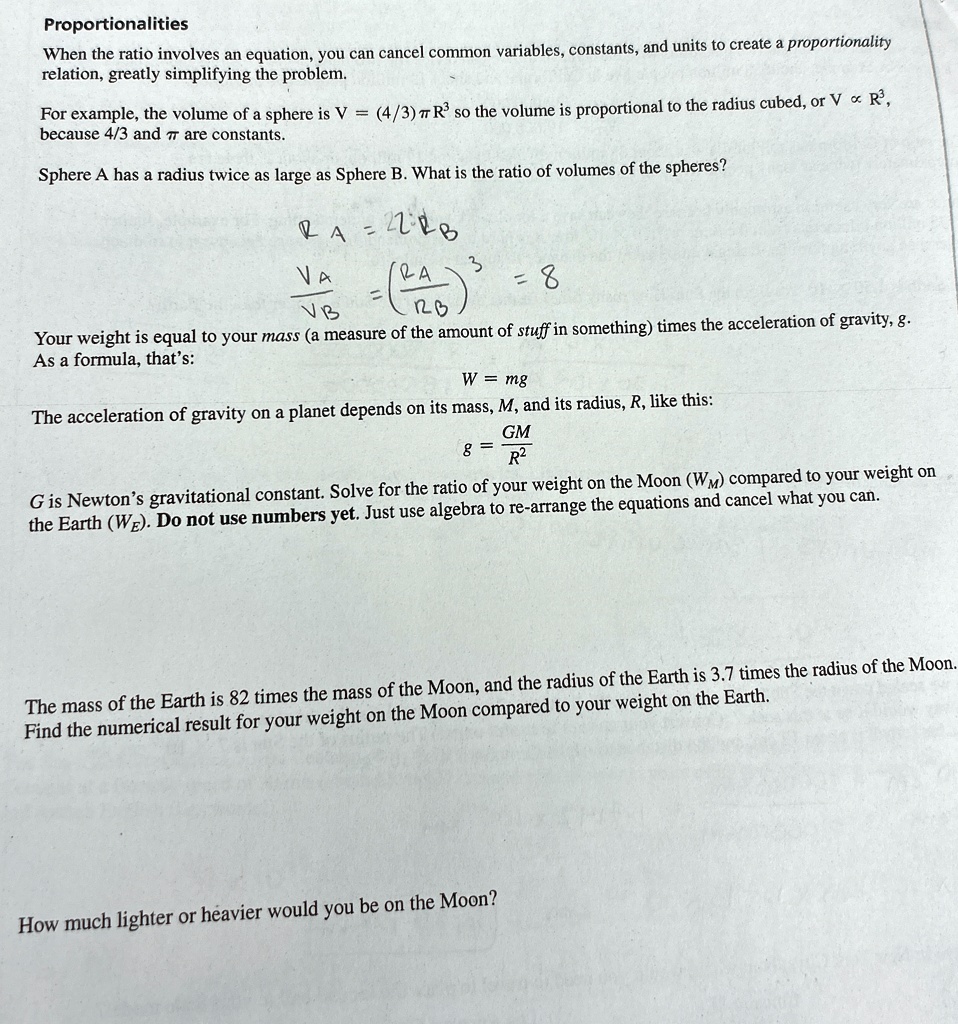
Proportionalities
When the ratio involves an equation, you can cancel common variables, constants, and units to create a proportionality
relation, greatly simplifying the problem.
For example, the volume of a sphere is V = (4/3)?R³ so the volume is proportional to the radius cubed, or V ? R³,
because 4/3 and ? are constants.
Sphere A has a radius twice as large as Sphere B. What is the ratio of volumes of the spheres?
$\frac{R_A}{R_B} = 2$
$\frac{V_A}{V_B} = \left(\frac{R_A}{R_B}\right)^3 = 8$
Your weight is equal to your mass (a measure of the amount of stuff in something) times the acceleration of gravity, g.
As a formula, that's:
W = mg
The acceleration of gravity on a planet depends on its mass, M, and its radius, R, like this:
g = $\frac{GM}{R^2}$
G is Newton's gravitational constant. Solve for the ratio of your weight on the Moon (W$_M$) compared to your weight on
the Earth (W$_E$). Do not use numbers yet. Just use algebra to re-arrange the equations and cancel what you can.
The mass of the Earth is 82 times the mass of the Moon, and the radius of the Earth is 3.7 times the radius of the Moon.
Find the numerical result for your weight on the Moon compared to your weight on the Earth.
How much lighter or heavier would you be on the Moon?