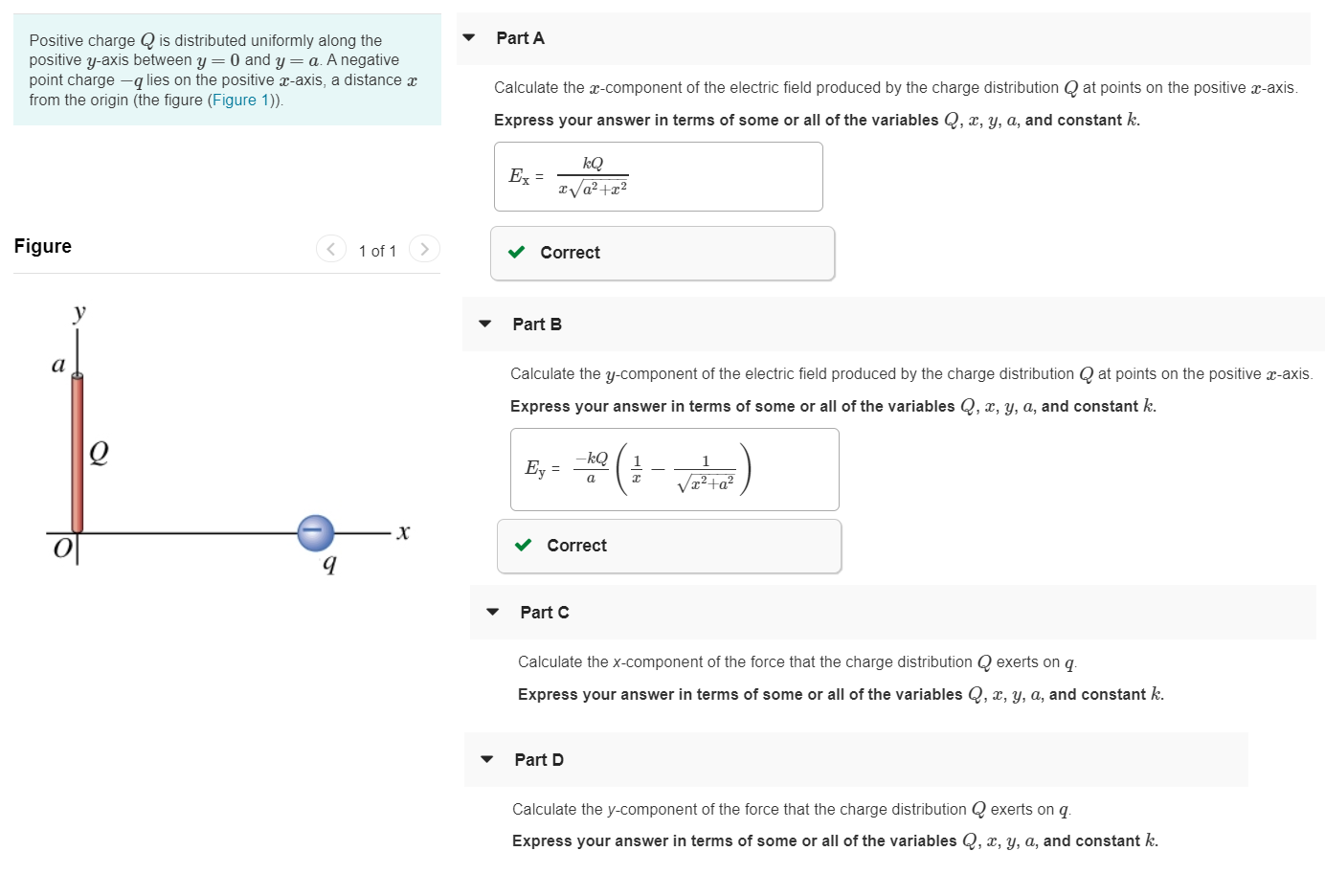
Positive charge \( Q \) is distributed uniformly along the positive \( y \)-axis between \( y=0 \) and \( y=a \). A negative point charge \( -q \) lies on the positive \( x \)-axis, a distance \( x \) from the origin (the figure (Figure 1)).
Figure
1 of 1
Part A
Calculate the \( x \)-component of the electric field produced by the charge distribution \( Q \) at points on the positive \( x \)-axis.
Express your answer in terms of some or all of the variables \( Q, x, y, a \), and constant \( k \).
\[
E_{\mathrm{x}}=\frac{k Q}{x \sqrt{a^{2}+x^{2}}}
\]
Correct
Part B
Calculate the \( y \)-component of the electric field produced by the charge distribution \( Q \) at points on the positive \( x \)-axis.
Express your answer in terms of some or all of the variables \( Q, x, y, a \), and constant \( k \).
\[
E_{\mathrm{y}}=\frac{-k Q}{a}\left(\frac{1}{x}-\frac{1}{\sqrt{x^{2}+a^{2}}}\right)
\]
Correct
Part C
Calculate the x-component of the force that the charge distribution \( Q \) exerts on \( q \).
Express your answer in terms of some or all of the variables \( Q, x, y, a \), and constant \( k \).
Part D
Calculate the \( y \)-component of the force that the charge distribution \( Q \) exerts on \( q \).
Express your answer in terms of some or all of the variables \( Q, x, y, a \), and constant \( k \).