Questions asked
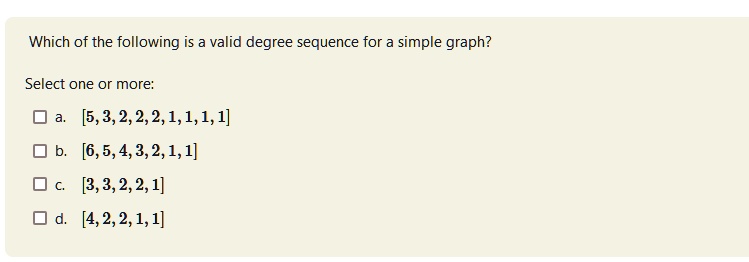
Which of the following is a valid degree sequence for a simple graph? Select one or more: a. [5, 3, 2, 2, 2, 1, 1, 1, 1] b. [6, 5, 4, 3, 2, 1, 1] c. [3, 3, 2, 2, 1] d. [4, 2, 2, 1, 1]
please give me a ready research proposal on economic and finance in the context of Afghanistan current situation
Describe Max Weber's "multidimensional" perspective of conflict in society (class, status, and party).
Which of the following is not true regarding the double entry, system? debits must equal credits assets must equal liabilities plus stockholders equity
A tree in Aldo's backyard has been growing for \( 2 \frac{1}{5} \) years. The tree is \( \frac{7}{8} \) meters tall. What is the unit rate in meters per year? Write your answer as a fraction or a mixed number in simplest form. meters per year
Which of the following statements is true about the improper integral ∫₀⁵ (1)/(x²-2x+1)dx? It converges to (5)/(4) It diverges. It converges to ln16 It converges to (-5)/(4)
In questions 9 - 11, solve the exponential expression. Express the solutions in terms of logarithms and obtain a decimal correct to two decimal places. 9. $e^{4z-5} - 7 = 11,243$ 10. $5^{2z+3} = 3^{2-1}$ 11. $e^{4z} - 3e^{2z} - 18 = 0$
The text appears to be free of spelling, typographical, grammatical, OCR, and mathematical errors.
Perpendicular lines ℓ1 and ℓ2 have slopes m1 and m2, respectively. Find m2 if m1 equals the following. (If an answer is undefined, enter UNDEFINED.) (a) -1/7 m2= (b) 5/7 m2= (c) 9 m2= (d) a+b/c+d m2=
Problem 1 [50 points] For each of the following languages, construct a Turing machine in JFLAP, version 7, that decides the language. To receive full credit for each language, you must submit three files: (1) the JFLAP file (e.g., 1a.jff); (2) a text file (e.g., 1a-accept.txt) with five strings that are in the language, one per line; and (3) a text file (e.g., 1a-reject.txt) with five strings that are not in the language, one per line. In total, you should have 9 files. Note that there is no explicit reject state in JFLAP. We assume that there is a transition to the reject state whenever a state lacks an outgoing transition for a particular symbol. c. $C = \{w\#w\#w \mid w \in \{0, 1\}^*\}$