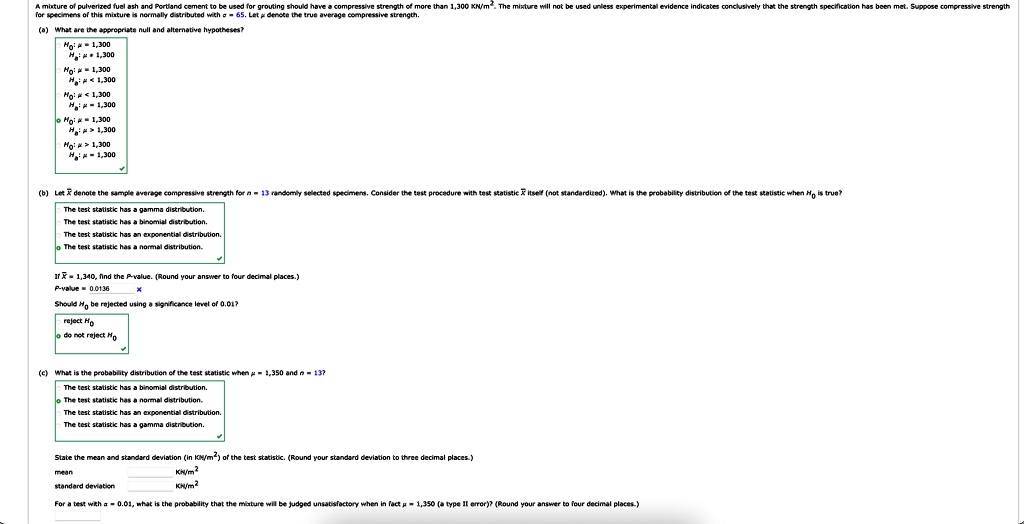
A mixture of pulverized fuel ash and Portland cement to be used for grouting should have a compressive strength of more than 1,300 KN/m². The mixture will not be used unless experimental evidence indicates conclusively that the strength specification has been met. Suppose compressive strength for specimens of this mixture is normally distributed with $\sigma = 65$. Let $\mu$ denote the true average compressive strength.
(a) What are the appropriate null and alternative hypotheses?
$H_0: \mu = 1,300$
$H_a: \mu \ne 1,300$
$H_0: \mu = 1,300$
$H_a: \mu < 1,300$
$H_0: \mu < 1,300$
$H_a: \mu = 1,300$
$H_0: \mu = 1,300$
$H_a: \mu > 1,300$
$H_0: \mu > 1,300$
$H_a: \mu = 1,300$
(b) Let $\bar{x}$ denote the sample average compressive strength for $n = 13$ randomly selected specimens. Consider the test procedure with test statistic $\bar{x}$ itself (not standardized). What is the probability distribution of the test statistic when $H_0$ is true?
The test statistic has a gamma distribution.
The test statistic has a binomial distribution.
The test statistic has an exponential distribution.
The test statistic has a normal distribution.
If $\bar{x} = 1,340$, find the P-value. (Round your answer to four decimal places.)
P-value = 0.0136
Should $H_0$ be rejected using a significance level of 0.01?
reject $H_0$
do not reject $H_0$
(c) What is the probability distribution of the test statistic when $\mu = 1,350$ and $n = 13$?
The test statistic has a binomial distribution.
The test statistic has a normal distribution.
The test statistic has an exponential distribution.
The test statistic has a gamma distribution.
State the mean and standard deviation (in KN/m²) of the test statistic. (Round your standard deviation to three decimal places.)
mean
KN/m²
standard deviation
KN/m²
For a test with $\alpha = 0.01$, what is the probability that the mixture will be judged unsatisfactory when in fact $\mu = 1,350$ (a type II error)? (Round your answer to four decimal places.)