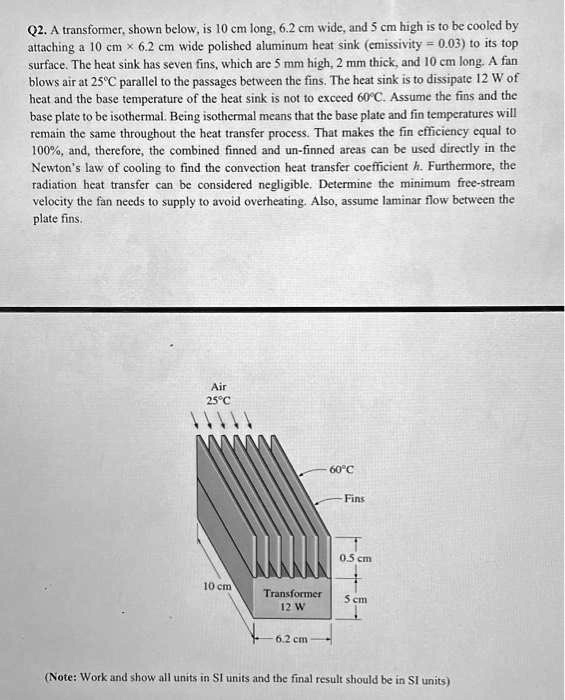
Q2. A transformer, shown below, is 10 cm long, 6.2 cm wide, and 5 cm high is to be cooled by attaching a 10 cm \times 6.2 cm wide polished aluminum heat sink (emissivity = 0.03) to its top surface. The heat sink has seven fins, which are 5 mm high, 2 mm thick, and 10 cm long. A fan blows air at 25°C parallel to the passages between the fins. The heat sink is to dissipate 12 W of heat and the base temperature of the heat sink is not to exceed 60°C. Assume the fins and the base plate to be isothermal. Being isothermal means that the base plate and fin temperatures will remain the same throughout the heat transfer process. That makes the fin efficiency equal to 100%, and, therefore, the combined finned and un-finned areas can be used directly in the Newton's law of cooling to find the convection heat transfer coefficient $h$. Furthermore, the radiation heat transfer can be considered negligible. Determine the minimum free-stream velocity the fan needs to supply to avoid overheating. Also, assume laminar flow between the plate fins.
(Note: Work and show all units in SI units and the final result should be in SI units)