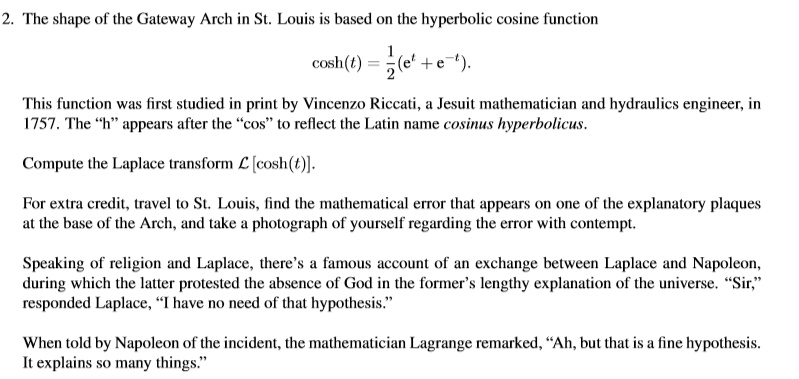
2. The shape of the Gateway Arch in St. Louis is based on the hyperbolic cosine function
$\cosh(t) = \frac{1}{2}(e^t + e^{-t})$.
This function was first studied in print by Vincenzo Riccati, a Jesuit mathematician and hydraulics engineer, in
1757. The \"h\" appears after the \"cos\" to reflect the Latin name cosinus hyperbolicus.
Compute the Laplace transform $\mathcal{L}\left[\cosh(t)\right]$.
For extra credit, travel to St. Louis, find the mathematical error that appears on one of the explanatory plaques
at the base of the Arch, and take a photograph of yourself regarding the error with contempt.
Speaking of religion and Laplace, there's a famous account of an exchange between Laplace and Napoleon,
during which the latter protested the absence of God in the former's lengthy explanation of the universe. \"Sir,\"
responded Laplace, \"I have no need of that hypothesis.\"
When told by Napoleon of the incident, the mathematician Lagrange remarked, \"Ah, but that is a fine hypothesis.
It explains so many things.\"