Ace - AI Tutor
Ask Our Educators
Textbooks
My Library
Flashcards
Scribe - AI Notes
Notes & Exams
Download App
sara harper

sara h.

Divider

Questions asked

BEST MATCH

What is the problem with waiting to list a species until they have already reached threatened or endangered status?

View Answer
divider
BEST MATCH

True or false during the prohibition period of the 1920's and 1930's alcohol dependence and alcohol related deaths are higher

View Answer
divider
BEST MATCH

The two blocks, as shown in Fig. Q8 start from rest. The 10 horizontal plane and the pulley are frictionless and the pulley is assumed to be of negligible mass. Determine the acceleration of each block and the tension in the cord.

View Answer
divider
BEST MATCH

1. The Quantity Theory and the Fisher Effect Assume that the growth rate of GDP in 2019 was 5%, while the inflation rate was 3%. Assume that the nominal interest rate is 6%. a. What growth rate of money supply would be necessary to be consistent with the quantity theory? b. Using your Fisher equation, what should the real interest rate be Now suppose that the central bank decides to decrease the money growth rate to 5%. c. What should the new inflation rate and interest rate be (Assuming classical dichotomy holds)?

View Answer
divider
BEST MATCH

5 < Question 7 of 9 > Macmillan Learning Zack met a woman in the library and immediately thought he knew her. He then asked her, "Have I met you before?" She replied no and walked away. This could have been an example of: déjà vu. implicit memory processing. repression. automatic processing.

View Answer
divider
BEST MATCH

Protistas and Fungi are: a. Prokaryotes No answer text provided. b. Eukaryotes No answer text provided.

View Answer
divider
BEST MATCH

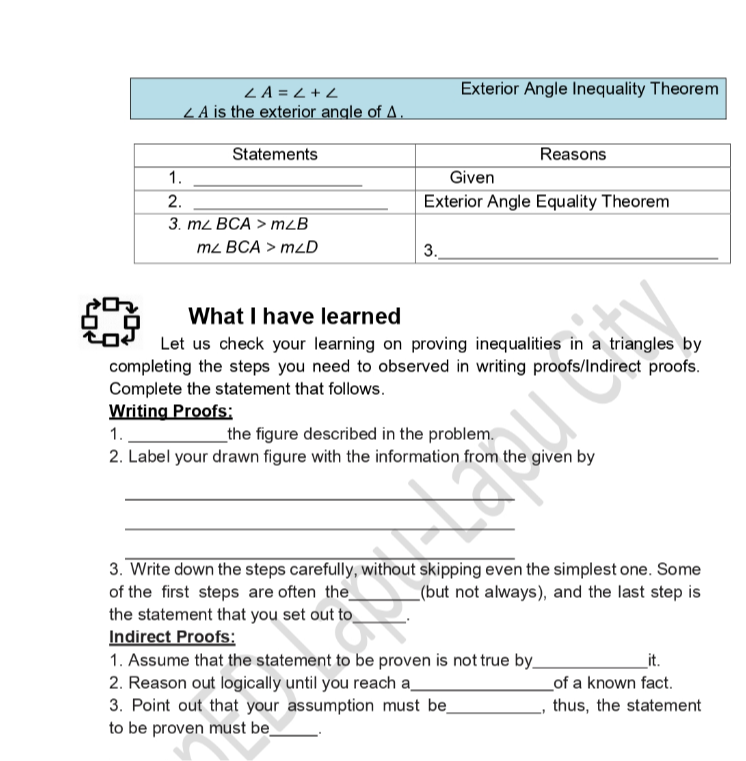
\( \angle A=\angle+\angle \) Exterior Angle Inequality Theorem \( \angle A \) is the exterior anale of \( \triangle \). \begin{tabular}{|c|c|} \hline Statements & Reasons \\ \hline\( \square \) & Given \\ \hline 2. & Exterior Angle Equality Theorem \\ \hline 3. \begin{array}{l}\( m \angle B C A>m \angle B \\ m \angle B C A>m \angle D\end{array} \) & 3. \\ \hline \end{tabular} What I have learned Let us check your learning on proving inequalities in a triangles by completing the steps you need to observed in writing proofs/Indirect proofs. Complete the statement that follows. Writing Proofs: 1. \( \qquad \) the figure described in the problem. 2. Label your drawn figure with the information from the given by \( \qquad \) \( \qquad \) \( \qquad \) 3. Write down the steps carefully, without skipping even the simplest one. Some of the first steps are often the \( \qquad \) (but not always), and the last step is the statement that you set out to \( \qquad \) Indirect Proofs: 1. Assume that the statement to be proven is not true by \( \qquad \) it. 2. Reason out logically until you reach a \( \qquad \) of a known fact. 3. Point out that your assumption must be \( \qquad \) , thus, the statement to be proven must be \( \qquad \)
View Answer
divider
BEST MATCH

The nurse is caring for a client with peripheral edema who has just begun taking a diuretic. What assessments should the nurse use to evaluate the effectiveness of this medication? Select all that apply. Question 19 options: Daily weights Chest auscultation Level of consciousness Urine output Inspection of the lower legs and feet

View Answer
divider
BEST MATCH

[UCONN 1071Q] Consider $f(x) = \begin{cases} \frac{x^2 + x - 6}{x - 2} & x \le 3\\ 2x^2 - 12 & x > 3 \end{cases}$, Compute the following limits and enter your answers below rounded to the nearest tenth (For example express 7 as 7.0 and 5.72 as 5.7). If the limit does not exist, enter DNE. (a) $\lim_{x \to 2} (f(x))$ (b) $\lim_{x \to 3} (f(x))$

View Answer
divider
BEST MATCH

a. Provide a detailed balanced equation for a chemical reaction that involves at least two reactants and produces at least two products. b. Provide gram amounts of both reactants and determine how much mass in grams of one of the products would be produced by using either a BCA table or by using dimensional analysis. Identify which reactant is the limiting reactant. c. How would you estimate the enthalpy change for the reaction to determine whether the reaction was endothermic or exothermic?

View Answer
divider