Ace - AI Tutor
Ask Our Educators
Textbooks
My Library
Flashcards
Scribe - AI Notes
Notes & Exams
Download App
sara johnston

sara j.

Divider

Questions asked

BEST MATCH

Select the person who is most clearly demonstrating initiative. A.) A teacher who uses the same lesson plans every year. B.) A nurse who stays late to help manage the higher than normal number of patients. C.) An employee who always checks with his manager before making a decision. D.) A child who cleans his room when his father asks him to.

View Answer
divider
BEST MATCH

8) Consider the random processes $X[n] = U[n]$ and $Y[n] = U[n] - bU[n-1]$, where $U[n]$ is white Gaussian noise with variance $\sigma_u^2 = 1$. Find $r_{x,y} = [k]$ and then to verify your results perform a computer simulation. To do so first generate $N = 1000$ samples of $X[n]$ and $Y[n]$. Then, estimate the CCS for $b =$ $-0.1$ and $b = -1$. Explain your results.

View Answer
divider
BEST MATCH

ENTROPY IN CALORIMETRY Suppose that, in a large room, a 205 g piece of hot piece of metal is placed into a 492 g ice-water bath that is 27% ice by mass. The metal has a specific heat capacity of 0.63 J/(g \cdot K) and is initially at a temperature of 71.5°C. In the process of coming to equilibrium with the room, the sub-system of the ice- water and metal gains 61.6 kJ from the room. What is the temperature of the room? $T_f = $ °C

View Answer
divider
BEST MATCH

Stock warrants outstanding should be classified as A O liabilities. O paid-in capital. O assets. O reductions of capital contributed in excess of par value.

View Answer
divider
BEST MATCH

One of the sides x, y and r of the triangle in the figure below is given. Find exact values of the other two sides. Find the values of x and y in the figure, given that A = 32°, B = 58°, r = 16. Round your answers to three decimal places. x = y =

View Answer
divider
BEST MATCH

PRACTICE IT Use the worked example above to help you solve this problem. Two converging lenses are placed $d_2 =$ 22.0 cm apart, as shown in figure a, with an object $d_1 = 33.0$ cm in front of lens 1 on the left. (a) If lens 1 has a focal length of $f_1 = 11.0$ cm, locate the image formed by this lens and determine its magnification. $q =$ 16.5 cm $M = -5$ (b) If lens 2 on the right has a focal length of $f_2 = 22.0$ cm, locate the image formed and find the total magnification of the system. $q = -7.33$ $M = -665$ EXERCISE HINTS: GETTING STARTED I'M STUCK! If the two lenses in the figure are separated by 11.0 cm, locate the final image and find the magnification of the system. (Hint: The object for the second lens is virtual!) (Use the necessary information from the Practice It portion of the problem.) $q =$ cm $M = $

View Answer
divider
BEST MATCH

Activity 1 Activity 2 Activity 3 John EU 64 30 71.5 CE 256 120 226 RP -128 60 113 Kelly EU 80.25 38.73 68.17 CE 655.36 144 510.76 RP -527.36 -84 -397.76 Sarah EU 1208 180 743 CE 50.6 34.64 47.54 RP 77.4 25.36 65.46 EU = Expected Utility / CE = Certainty Equivalent / RP = Risk Premium

View Answer
divider
BEST MATCH

1. Write a behavioral module for a full-adder in Verilog. (Hint - an assign statement can be used to compactly describe each output.) 2. Draw the block diagram for an 8-bit unsigned adder. 3. Draw the block diagram for an 8-bit unsigned multiplier. Use 8-bit ripple-carry adders instead of full adders in your diagram. Use bus notation where appropriate. To simplify your diagram, you may only use one AND gate per row. The implicit notation here is that (A[7:0] AND B[0]) implies that B[0] is AND'ed bitwise with A[7:0]. Write major bus names on your diagram. 4. For the 8-bit unsigned multiplier, give the minimum and maximum value of the input operands and the minimum and maximum value of the output product. How many bits are needed at the output of the multiplier to ensure that all possible products can be fully represented?

View Answer
divider
BEST MATCH

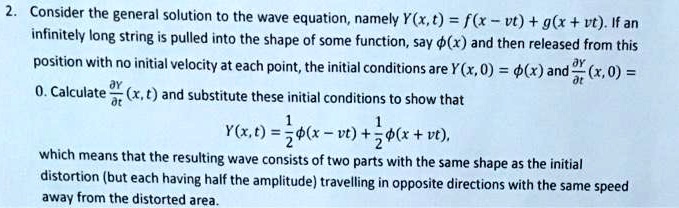
2. Consider the general solution to the wave equation, namely Y(x, t) = f(x - vt) + g(x + vt). If an infinitely long string is pulled into the shape of some function, say ?(x) and then released from this position with no initial velocity at each point, the initial conditions are Y(x, 0) = ?(x) and ?Y/?t(x, 0) = 0. Calculate ?Y/?t(x, t) and substitute these initial conditions to show that Y(x, t) = 1/2 ?(x - vt) + 1/2 ?(x + vt), which means that the resulting wave consists of two parts with the same shape as the initial distortion (but each having half the amplitude) travelling in opposite directions with the same speed away from the distorted area.
View Answer
divider
BEST MATCH

Which small business-related forms were converted to continuous use in 2022? Form 1065 and Form 1120S.

View Answer
divider