24. [3] As a universal insurance program, Medicare enrollees are not required to pay premiums.
25. [3] In Medicaid expansion states, most of the newly enrolled were eligible for Medicaid even before the expansion.
26. [3] Medicare covers any and all medically effective treatments.
27. [3] Medicare fully covers patient costs (ignoring premiums, if there are premiums, which are not a patient cost), which aggravates moral hazard.
28. [3] The confluence of employer-sponsored health insurance, wage-pass through, and sticky wages, known as job-lock, distorts labor markets and reduces social welfare.
29. [3] There is causal evidence to suggest wage pass through of (ostensibly higher healthcare costs to obese people in the form of lower wages.
30. [3] Queuing is an efficient way of reducing moral hazard because there is no cost associated with it.
31. [3] A universal, single-payer system eliminates adverse selection.
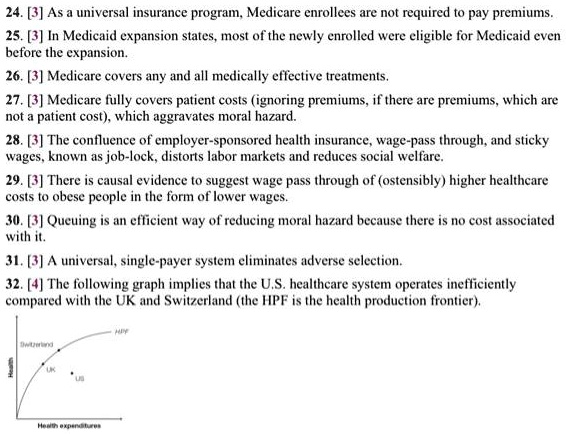
32. [4] The following graph implies that the U.S. healthcare system operates inefficiently compared with the UK and Switzerland (the HPF is the health production frontier).