Question 3
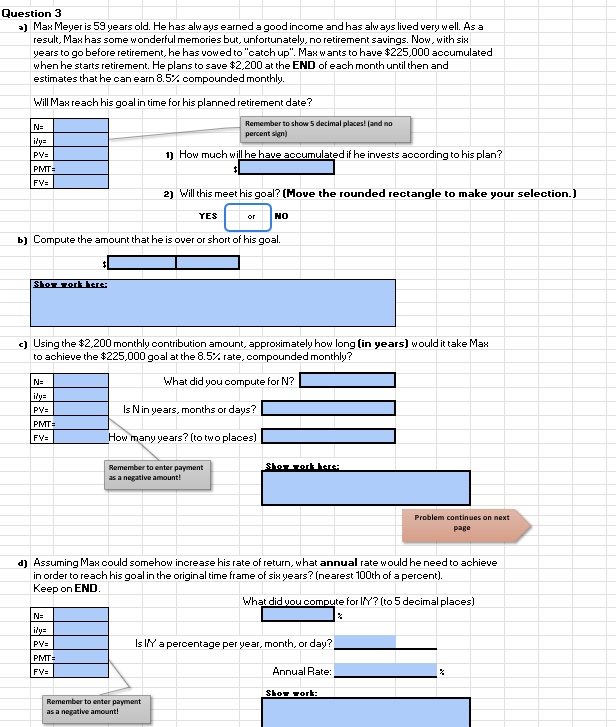
a) Max Meyer is 59 years old. He has always earned a good income and has always lived very well. As a result, Max has some wonderful memories but, unfortunately, no retirement savings. Now, with six years to go before retirement, he has vowed to "catch up". Max wants to have $225,000 accumulated when he starts retirement. He plans to save $2,200 at the END of each month until then and estimates that he can earn 8.5% compounded monthly.
Will Max reach his goal in time for his planned retirement date?
N=
ily=
PV=
PMT=
FV=
Remember to show 5 decimal places! (and no percent sign)
1) How much will he have accumulated if he invests according to his plan?
$
2) Will this meet his goal? (Move the rounded rectangle to make your selection.)
YES
or
NO
b) Compute the amount that he is over or short of his goal.
Show work here:
c) Using the $2,200 monthly contribution amount, approximately how long (in years) would it take Max to achieve the $225,000 goal at the 8.5% rate, compounded monthly?
N=
ily=
PV=
PMT=
FV=
What did you compute for N?
Is N in years, months or days?
How many years? (to two places)
Remember to enter payment as a negative amount!
Show work here:
Problem continues on next page
d) Assuming Max could somehow increase his rate of return, what annual rate would he need to achieve in order to reach his goal in the original time frame of six years? (nearest 100th of a percent).
Keep on END.
What did you compute for IY? (to 5 decimal places)
Is IY a percentage per year, month, or day?
N=
ily=
PV=
PMT=
FV=
Remember to enter payment as a negative amount!
Annual Rate:
Show work:
%