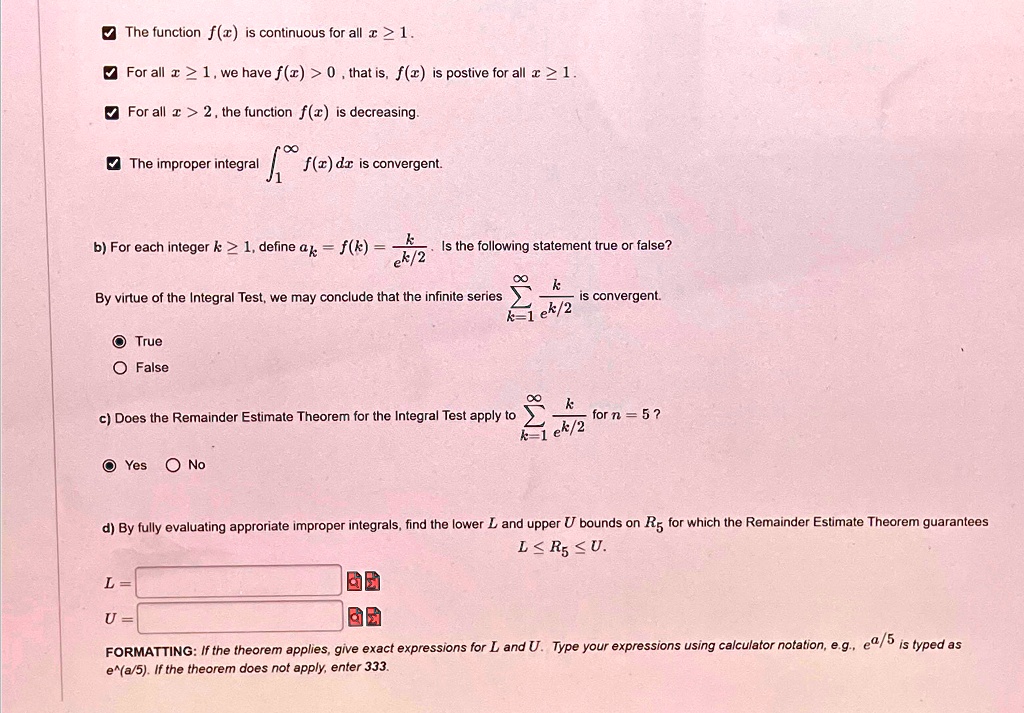
The function f(x) is continuous for all x>=1.
For all x>=1, we have f(x)>0, that is, f(x) is positive for all x>=1.
For all x>2, the function f(x) is decreasing.
The improper integral ∫_1^(∞) f(x)dx is convergent.
b) For each integer k>=1, define a_(k)=f(k)=(k)/(e^(k/2)). Is the following statement true or false?
By virtue of the Integral Test, we may conclude that the infinite series ∑_(k=1)^(∞) (k)/(e^(k/2)) is convergent.
True
False
c) Does the Remainder Estimate Theorem for the Integral Test apply to ∑_(k=1)^(∞) (k)/(e^(k/2)) for n=5?
Yes
No
d) By fully evaluating appropriate improper integrals, find the lower L and upper U bounds on R_(5) for which the Remainder Estimate Theorem guarantees
L<=R_(5)<=U.
L=
U=
FORMATTING: If the theorem applies, give exact expressions for L and U. Type your expressions using calculator notation, e.g., e^(a/5) is typed as e^(a/5). If the theorem does not apply, enter 333.
The function f is continuous for all x>1.
For all x>1, we have f>0, that is, f is positive for all x.
For all x>2, the function f is decreasing.
The improper integral fd is convergent.
Is the following statement true or false? ek/2 8 k By virtue of the Integral Test, we may conclude that the infinite series is convergent. k=1ek/2
False
c) Does the Remainder Estimate Theorem for the Integral Test apply to for n=5 k=1ek/2 Yes No
d) By fully evaluating appropriate improper integrals, find the lower L and upper U bounds on R for which the Remainder Estimate Theorem guarantees LR5U.
L
U FORMATTING: If the theorem applies, give exact expressions for L and U. Type your expressions using calculator notation, e.g., ea/5 is typed as e^a/5. If the theorem does not apply, enter 333