est 2: Truss Analysis by Method of Sections
e Method of Sections
MECHANICS OF STRUCTURES
<2012
warning Goal:
apply the method of sections to find the forces in specific members
of a truss
member of
the method of sections is used to find the force in a specific
truss and is based on the principle that, if a body is in equilibrium,
then every part of that body is also in equilibrium. When applied, the
method of sections \"cuts\" or sections the members of a truss and
exposes their internal forces. To find the unknown internal member
forces, the free-body diagram of a section is drawn and the equations
of equilibrium are applied
$\sum F_x = 0$
$\sum F_y = 0$
$\sum M_O = 0$
Cause there are only three independent equilibrium equations,
section cuts should be made such that there are not more than three
members that have unknown forces
Significant Figures Feedback: Your answer 301.31 N was either rounded differently or used a different number of significant figures than required for this
part. If you need this result for any later calculation in this assessment, keep all the digits and round as the final step before submitting your answer.
Part B
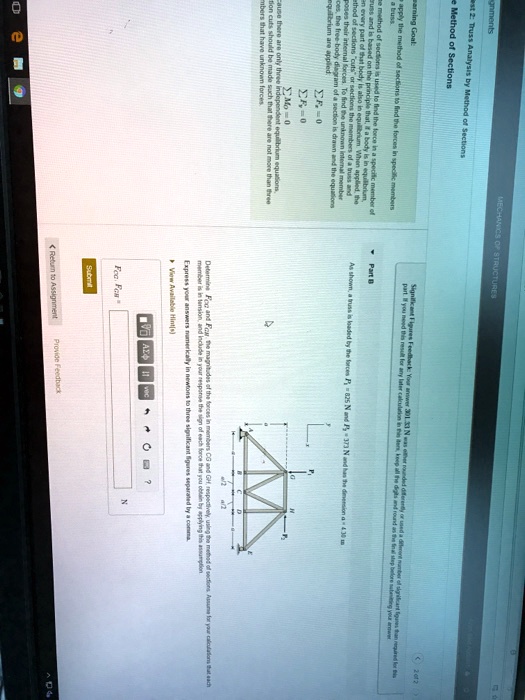
As shown, a truss is loaded by the forces $P_1 = 825 \text{ N}$ and $P_2 = 373 \text{ N}$ and has the dimension $a = 4.30 \text{ m}$
$P_1$
$P_2$
G
H
N
C
D
2
a
a
Determine $F_{CG}$ and $F_{GH}$, the magnitudes of the forces in members CG and GH, respectively, using the method of sections. Assume for your calculations that each
member is in tension, and include in your response the sign of each force that you obtain by applying this assumption
Express your answers numerically in newtons to three significant figures separated by a comma.
$\rightarrow$ View Available Hint(s)
$F_{CG}, F_{GH}$ =
Submit
<Return to Assignment
Provide Feedback
^04