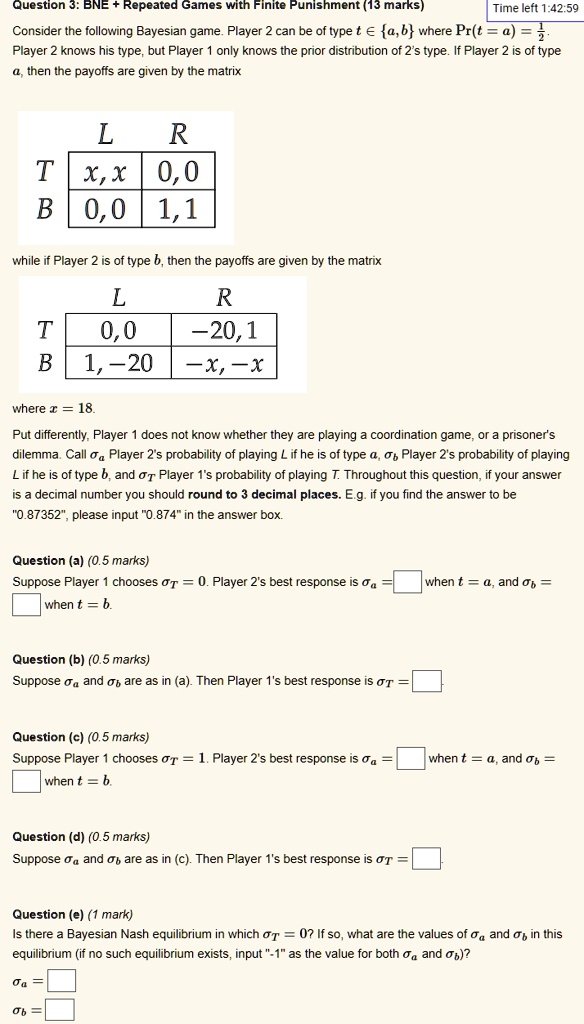
Consider the following Bayesian game. Player 2 can be of type tin{a,b} where Pr(t=a)=(1)/(2).
Player 2 knows his type, but Player 1 only knows the prior distribution of 2's type. If Player 2 is of type
a, then the payoffs are given by the matrix
while if Player 2 is of type b, then the payoffs are given by the matrix
where x=18.
Put differently, Player 1 does not know whether they are playing a coordination game, or a prisoner's
dilemma. Call sigma _(a) Player 2's probability of playing L if he is of type a,sigma _(b) Player 2's probability of playing
L if he is of type b, and sigma _(T) Player 1's probability of playing T. Throughout this question, if your answer
is a decimal number you should round to 3 decimal places. E.g. if you find the answer to be
"0.87352", please input " 0.874 " in the answer box.
Question (a) (0.5 marks)
Suppose Player 1 chooses sigma _(T)=0. Player 2's best response is sigma _(a)=, when t=a, and sigma _(b)=
when t=b.
Question (b) (0.5 marks)
Suppose sigma _(a) and sigma _(b) are as in (a). Then Player 1's best response is sigma _(T)=
Question (c) (0.5 marks)
Suppose Player 1 chooses sigma _(T)=1. Player 2's best response is sigma _(a)=, when t=a, and sigma _(b)=
when t=b.
Question (d) (0.5 marks)
Suppose sigma _(a) and sigma _(b) are as in (c). Then Player 1's best response is sigma _(T)=
Question (e) (1 mark)
Is there a Bayesian Nash equilibrium in which sigma _(T)=0 ? If so, what are the values of sigma _(a) and sigma _(b) in this
equilibrium (if no such equilibrium exists, input "-1" as the value for both sigma _(a) and sigma _(b) )?
sigma _(a)=
sigma _(b)=
Question 3: BNE + Repeated Games with Finite Punishment (13 marks)
Time left 1:42:59
Player 2 knows his type, but Player 1 only knows the prior distribution of 2's type. If Player 2 is of type a,then the payoffs are given by the matrix
L
R T x,x 0,0 B 0,0 1,1
while if Player 2 is of type b, then the payoffs are given by the matrix
L 0,0 1, 20
R
T B
20,1
x-x-
where=18.
Put differently, Player 1 does not know whether they are playing a coordination game, or a prisoner's dilemma. Call Player 2's probability of playing L if he is of type , Player 2's probability of playing L if he is of type b, and T Player 1's probability of playing T. Throughout this question, if your answer is a decimal number you should round to 3 decimal places. E.g. if you find the answer to be "0.87352, please input "0.874 in the answer box
Question (a(0.5marks)
Suppose Player 1 chooses = 0. Player 2's best response is
whent=and=
when t = b.
Question (b) (0.5 marks) Suppose and are as in (a). Then Player 1's best response is T =
Question(c(0.5marks
Suppose Player 1 chooses =1.Player 2's best response is when t=b.
whent=aand=
Question (d) (0.5 marks) Suppose and are as in (c.Then Player 1's best response is T =
Question (e) (1 mark) Is there a Bayesian Nash equilibrium in which T=O? If so, what are the values of and , in this equilibrium (if no such equilibrium exists, input -1 as the value for both and )?
Oa=
=90