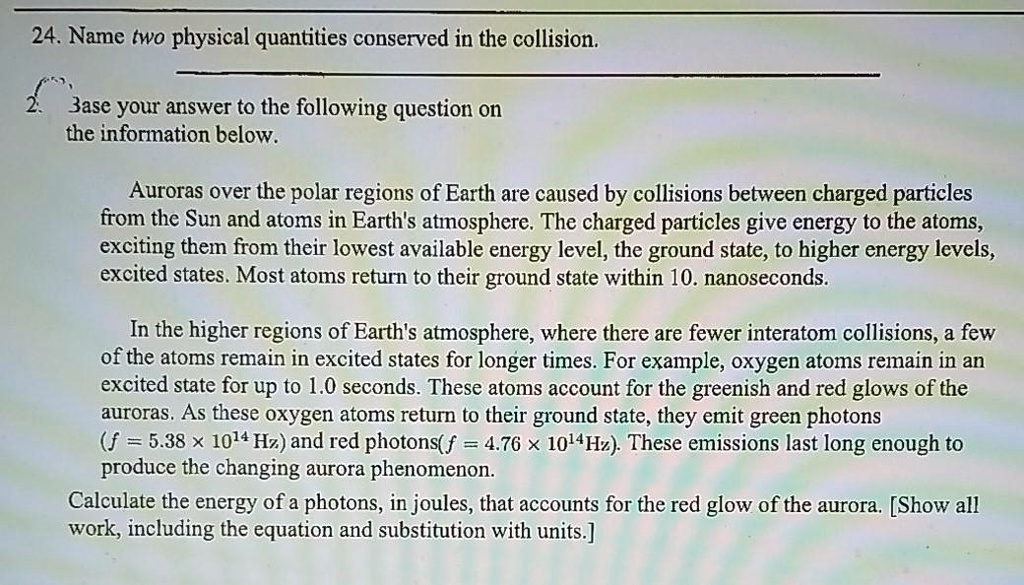
24. Name two physical quantities conserved in the collision.
2. Base your answer to the following question on
the information below.
Auroras over the polar regions of Earth are caused by collisions between charged particles
from the Sun and atoms in Earth's atmosphere. The charged particles give energy to the atoms,
exciting them from their lowest available energy level, the ground state, to higher energy levels,
excited states. Most atoms return to their ground state within 10. nanoseconds.
In the higher regions of Earth's atmosphere, where there are fewer interatom collisions, a few
of the atoms remain in excited states for longer times. For example, oxygen atoms remain in an
excited state for up to 1.0 seconds. These atoms account for the greenish and red glows of the
auroras. As these oxygen atoms return to their ground state, they emit green photons
(f = 5.38 \times 10^{14} Hz) and red photons(f = 4.76 \times 10^{14}Hz). These emissions last long enough to
produce the changing aurora phenomenon.
Calculate the energy of a photons, in joules, that accounts for the red glow of the aurora. [Show all
work, including the equation and substitution with units.]