Introduction
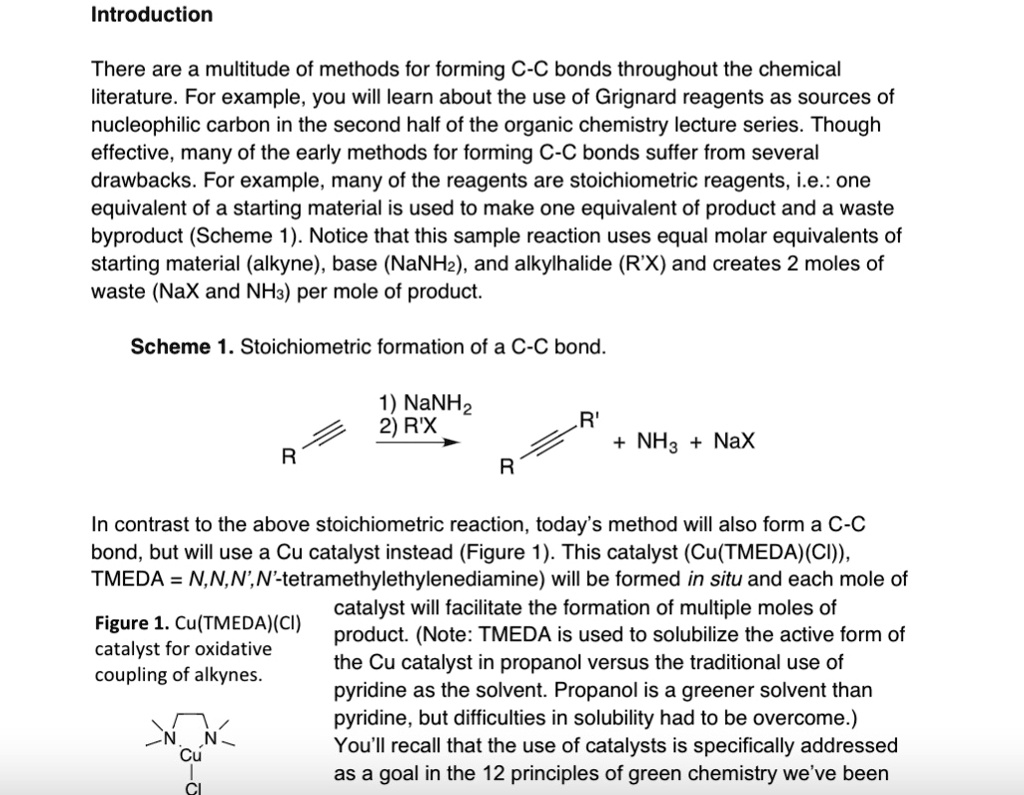
There are a multitude of methods for forming C-C bonds throughout the chemical literature. For example, you will learn about the use of Grignard reagents as sources of nucleophilic carbon in the second half of the organic chemistry lecture series. Though effective, many of the early methods for forming C-C bonds suffer from several drawbacks. For example, many of the reagents are stoichiometric reagents, i.e.: one equivalent of a starting material is used to make one equivalent of product and a waste byproduct (Scheme 1). Notice that this sample reaction uses equal molar equivalents of starting material (alkyne), base (NaNH2), and alkylhalide (R'X) and creates 2 moles of waste (NaX and NH3) per mole of product.
Scheme 1. Stoichiometric formation of a C-C bond
1) NaNH2 2) R'X
+ NH3 + NaX
In contrast to the above stoichiometric reaction, today's method will also form a C-C bond, but will use a Cu catalyst instead (Figure 1). This catalyst (Cu(TMEDA)(Cl)), TMEDA = N,N,N',N'-tetramethylethylenediamine) will be formed in situ and each mole of catalyst will facilitate the formation of multiple moles of product. (Note: TMEDA is used to solubilize the active form of the Cu catalyst in propanol versus the traditional use of pyridine as the solvent. Propanol is a greener solvent than pyridine, but difficulties in solubility had to be overcome.) You'll recall that the use of catalysts is specifically addressed as a goal in the 12 principles of green chemistry we've been.